From the lab to the next generation of startups
IBT Lower Saxony funds research projects from Göttingen and Braunschweig with almost 2.4 million euros
Advertisement


Better detection of lymph node metastases for a more precise cancer diagnosis or preventing hospital infections caused by multi-resistant bacteria: What many patients hope for has long been a topic of top-level research in Lower Saxony. The Institute for Biomedical Translation Lower Saxony (IBT), a state initiative under the umbrella of Niedersachsen.next, is funding two particularly promising projects with a total of almost 2.4 million euros so that innovative ideas from biomedicine can be transferred from the laboratory to practical application more quickly and help patients.
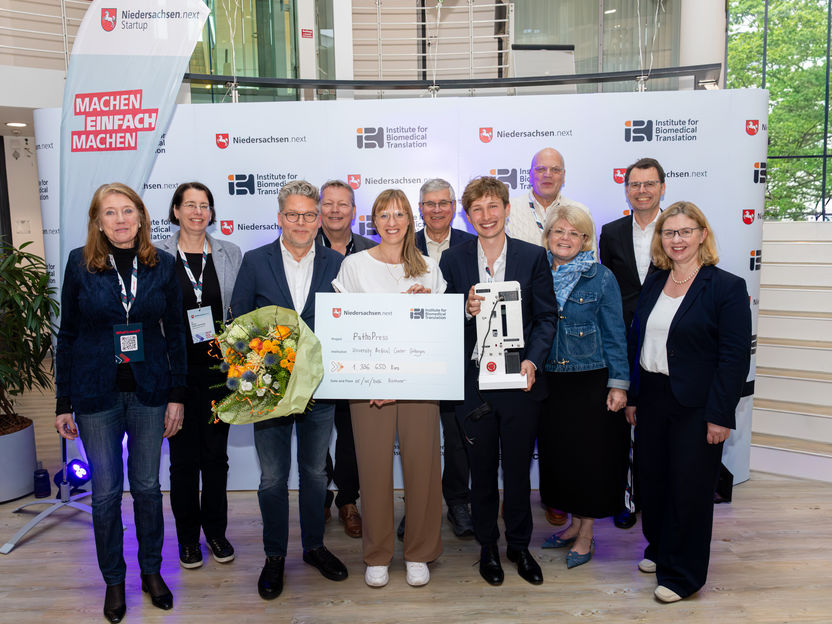
PathoPress project from the University Medical Center Göttingen
Marek Kruszewski / Niedersachsen.next
The selection of research projects pitching for funding at the sixth "IBT PRE-SEED Portfolio Conference" at the Medical Park Hannover was large and varied: it was about therapies for antibiotic-resistant (lung) infections in hospitals or pancreatic cancer, medical robotics, early and precise cancer diagnostics or the visualization of bacterial infections in wounds during an operation.
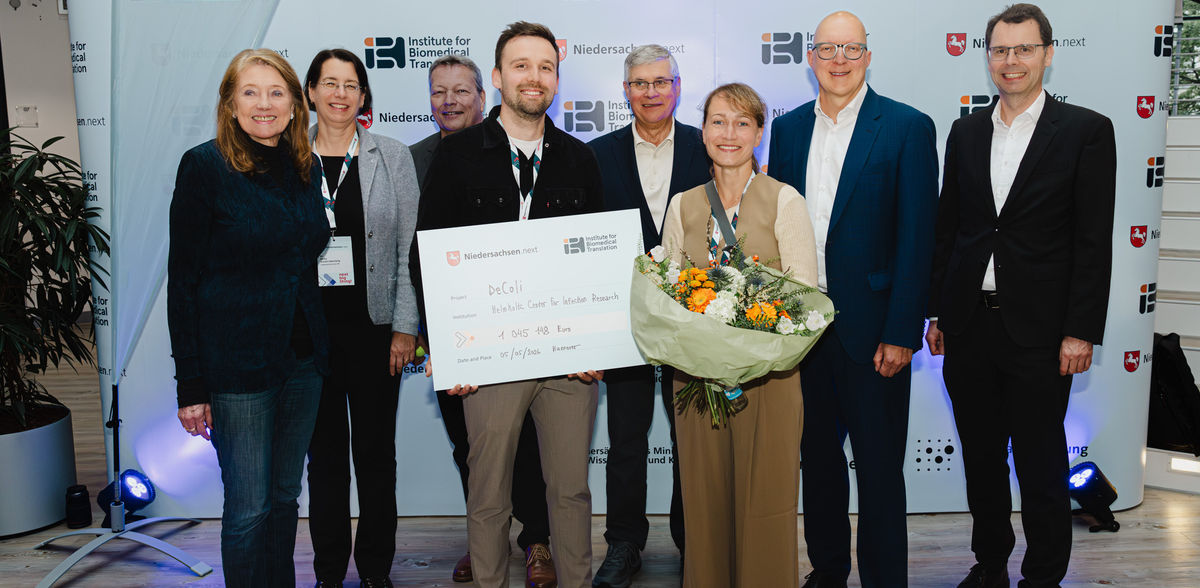
Finally, the PathoPress project from the University Medical Center Göttingen (1,336,650 euros) with the topic of cancer diagnostics and the DeColi project from the Helmholtz Centre for Infection Research Braunschweig (1,045,148 euros), which aims to proactively prevent hospital infections, secured the funding amounts. The high-caliber jury of academics, founders, industry and regulators selected these innovations as the most promising.
The project teams won through in presentation rounds against five other teams from research institutions in Lower Saxony. The PathoPress team came up with a special feature: 22-year-old Pedro Gebhardt Apalategui was the only student among the participants at the portfolio conference to lead the presentation. The pioneering method for cancer diagnostics, on which Prof. Philipp Ströbel and Friederike Mörk also answered questions, can now be further developed at full speed.
Inclusion in the IBT portfolio and a funding volume of this amount are associated with the opportunity to advance research results as quickly as possible and to make them commercially successful by founding a start-up. The IBT also provides support in the form of expert advice, coaching and networking. The DeColi project, for which Prof. Dr. Till Strowig, Prof. Dr. Julia Henkel and Dr. Christian Brandstetter pitched, will now also benefit from this.
Innovative minds from Lower Saxony - these are the winning projects
PathoPress - University Medical Center Göttingen (UMG): Precise cancer diagnostics depends largely on knowing exactly how far the disease has spread. A decisive factor is the reliable detection of lymph node metastases, which has a strong influence on staging, treatment decisions and treatment success. However, in routine pathology, the identification of lymph nodes in surgically removed tissue remains a labor-intensive and operator-dependent process - especially in cancers such as colorectal and ovarian cancer, where lymph nodes are embedded in large amounts of adipose tissue.
PathoPress introduces a novel device that mechanically compresses adipose tissue to significantly reduce its volume while maintaining full compatibility with standard histopathology and immunohistochemistry. By enabling a complete and standardized examination of the remaining tissue, this technology enables more reliable detection of all lymph nodes, reduces the workload for pathology staff, improves safety and workflow, and supports better treatment decisions. PathoPress aims to turn a simple physical principle into a practical diagnostic tool that can improve cancer staging and ultimately benefit patients worldwide.
DeColi - Helmholtz Center for Infection Research Braunschweig (HZI): Hospital-acquired infections caused by multidrug-resistant Gram-negative bacteria are a growing threat worldwide - often occurring when patients are at their most vulnerable. Colonization of the gut with pathogens such as Escherichia coli often occurs long before the development of serious infections such as sepsis, pneumonia, wound infections or recurrent urinary tract infections. DeColi is tackling this problem at the source by developing a live biotherapeutic product that selectively removes these dangerous bacteria from the gut before infection begins. The approach targets a large and high-risk patient population for whom there are no approved prevention options and utilizes a purposefully designed bacterial consortium with clearly defined functions.
This strategy, designed for reliable efficacy and scalable manufacturing, aims to prevent infections rather than react to them. DeColi offers a new, proactive way to reduce antibiotic-resistant infections and improve treatment outcomes for patients.
Tough decision for the jury
Lower Saxony is well positioned in the life sciences. This time, seven teams from the leading research institutions Leibniz Universität Hannover, Georg-August-Universität Göttingen, University Medical Center Göttingen and Helmholtz Centre for Infection Research in Braunschweig presented their innovations at the IBT event. The jury, chaired by Prof. Dr. Peter Hammann (Consultant, former Sanofi) and vice-chaired by Prof. Dr. Helga Rübsamen-Schaeff (founder of AiCuris), was spoiled for choice. The next and seventh IBT Portfolio Conference will take place in Göttingen in early 2027.
Prof. Dr. Thomas Sommer, Director of the IBT: "I am particularly pleased about two things: We are now seeing a constant number of applications for new projects. This clearly speaks for the innovative strength of Lower Saxony. And this time we have chosen two young teams who are highly committed to driving their spin-off ideas forward."
The IBT PRE-SEED Portfolio Conference took place as part of the "Transfer X Machen | IBT Life Science Edition" event organized by Niedersachsen.next, a day dedicated to the life sciences - with coaching, advice and networking formats for start-ups, researchers and investors.
From idea to foundation: Funding provides a tailwind
The two winning teams will receive the funding for a period of two years. This time will be used to further develop the projects in a scientific and market-oriented manner and, if necessary, to generate further funding so that the research and business ideas can be turned into a company. With PathoPress and DeColi, there are now twelve projects in the IBT portfolio with total funding of around 13 million euros.
The other finalists at the IBT Portfolio Conference in Hanover
DECYTE - Georg August University Göttingen: Abdominal complaints are common - and they don't always tell the whole story. The underlying causes range from harmless problems to life-threatening diseases such as colorectal carcinoma, the world's deadliest form of abdominal cancer. But today's screening methods have significant weaknesses: stool tests often miss precancerous lesions and early stages, and colonoscopy, while effective, is invasive for patients. DECYTE is developing a highly sensitive, blood-based test that uses artificial intelligence to detect colorectal cancer at very early stages by decoding subtle signals from the immune system - long before symptoms appear. The proof-of-concept shows: DECYTE achieves a sensitivity comparable to colonoscopy - without its invasiveness - and outperforms existing blood-based screening tests in terms of sensitivity and accuracy. By dispensing with invasive procedures and unreliable stool tests, this technology has the potential to fundamentally change cancer screening and to detect many other immune-associated diseases earlier in the future.
FLARE - Leibniz Universität Hannover (LUH): What if surgeons could see infections during surgery almost as clearly as anatomical structures? FLARE is developing sNIR, a novel dye for near-infrared imaging that enables real-time visualization during surgical procedures. Compared to standard dyes used today, sNIR provides higher contrast and faster results - and can be used with existing clinical imaging systems. Originally developed to detect brain tumors, the technology is now being extended to visualize bacterial infections in wounds or on implants and reliably distinguish them from harmless inflammations. By combining intelligent imaging probes with modern technologies such as surgical robots, this approach can make operations safer, reduce complications and ultimately save lives by providing better information when it is needed most.
PAERUBLOCK - Helmholtz Centre for Infection Research Braunschweig (HZI): Severe hospital-acquired lung infections caused by Pseudomonas aeruginosa are among the most difficult diseases to treat and represent a growing health threat worldwide. Instead of killing the bacteria directly, PAERUBLOCK takes a different approach: it targets a key enzyme that the pathogen uses to damage tissue, trigger inflammation and bypass the immune system. By rendering the bacteria harmless instead of attacking them directly, this antivirulence strategy enables the body's own defenses - and the available antibiotics - to fight infections more effectively. The approach helps to reduce the selection pressure for antibiotic resistance and lowers the risk of side effects usually associated with conventional antibiotic therapy. As the compounds have been shown to be highly effective in several disease models - especially in combination with standard antibiotics - and have favorable safety and drug profiles, the project is now advancing the preclinical and clinical development of these compounds, laying the foundation for a future spin-off focusing on safer and more sustainable infection treatments.
RESTORE-PDAC - University Medical Center Göttingen (UMG): Pancreatic ductal adenocarcinoma (PDAC) is one of the most aggressive and deadly cancers. However, current immunotherapies often fail because the tumor remains largely invisible to the immune system. RESTORE-PDAC addresses this challenge by developing novel small molecule modulators that help tumors become recognizable again. The approach focuses on restoring tumor antigenicity, enabling immune cells to more effectively recognize and attack pancreatic cancer (PDAC, pancreatic ductal adenocarcinoma). In preclinical studies, the lead structures improve antigen presentation, enhance T-cell activation and potentiate novel immunotherapies such as CAR T-cell responses. By reducing development risks and providing a clear path towards clinical translation, the potential of combined immunotherapies for pancreatic cancer will be unlocked - bringing new hope to a disease where more promising therapies are urgently needed.
RETRACT - University Medical Center Göttingen (UMG): In modern surgery, highly skilled professionals spend up to four hours a day performing manual retraction - holding organs to ensure access to the surgical field. This physically demanding, repetitive task contributes to fatigue and limits the efficient use of specialized surgical skills. RETRACT is developing a novel robotic assistance system that takes over this burden. The technology acts as an intuitive, always-available "third hand" and supports surgeons during procedures. In contrast to static instruments, the system is equipped with vibroacoustic and force-torque sensors that detect tissue tension and slippage in real time. Continuous adjustment of the position and constant tissue tension should significantly increase patient safety. RETRACT is a pioneer for solo surgery and combines patient safety with surgical efficiency.
Note: This article has been translated using a computer system without human intervention. LUMITOS offers these automatic translations to present a wider range of current news. Since this article has been translated with automatic translation, it is possible that it contains errors in vocabulary, syntax or grammar. The original article in German can be found here.


Other news from the department science













Most read news









More news from our other portals




















Something is happening in the life science industry ...
This is what true pioneering spirit looks like: Plenty of innovative start-ups are bringing fresh ideas, lifeblood and entrepreneurial spirit to change tomorrow's world for the better. Immerse yourself in the world of these young companies and take the opportunity to get in touch with the founders.