1.7 trillion euros of high-tech potential lies untapped in Germany
Germany is at risk of falling behind in the technology competition - but six key technologies could change that
Advertisement


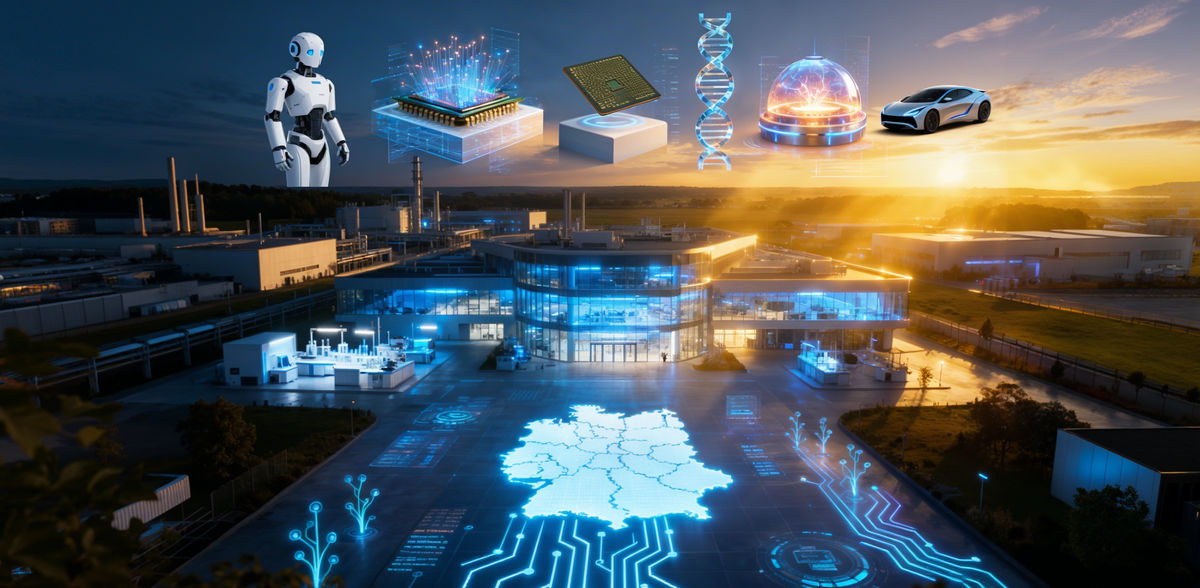
A high-tech potential of around 1.7 trillion euros offers German companies the opportunity to catch up decisively in the international technology competition. Central key technologies are the prerequisites for scaling value creation and expanding industrial strength in future lead markets - while other nations such as the USA and China are already systematically using these levers and thus increasing the pressure on Germany to act.
In their study "Growth Paths", BCG and UnternehmerTUM, Europe's largest center for innovation and business start-ups, show how a change of course can succeed. The focus is on the six key technologies of the High-Tech Agenda Germany (HTAD) of the Federal Ministry of Research, Technology and Space (BMFTR) - and the question of how technological strengths can be translated more quickly into scalable business models and sustainable growth.
Too little innovation, too little capital
Germany's innovation system has considerable growth potential - especially where scientific strength, scaling and capital are systematically combined. The study shows: When clear implementation structures and sufficient growth capital are available, value creation and returns are generated, especially in AI-driven future fields. This potential is already being exploited internationally - while Germany remains economically behind its potential despite a broad technological base. At around 930,000, the number of active patents in 2023 was below the level of the USA (3.5 million) and China (5 million). The difference is even clearer for high-growth technology companies: Around 700 unicorns have emerged in the USA and around 370 in China - compared to around 30 in Germany to date. There is also considerable catch-up potential in terms of growth capital: in 2024, investors in Germany invested less than 10 billion US dollars in venture capital, compared to 209 billion in the USA and around 40 billion in China. "The High-Tech Agenda is an opportunity to reinvent Germany as an industrial and technology location," says Michael Brigl, Senior Partner and Head of Central Europe at the Boston Consulting Group. "Key technologies such as artificial intelligence, microelectronics and biotechnology will not only determine who wins the economic race in the future. They are just as decisive for the resilience and sovereignty of our country."
Promising key technologies
- Artificial intelligence: Germany has excellent research, industry-related fields of application and internationally competitive companies, but lags behind the USA and China in terms of platforms, infrastructure and scaling. "Germany has strong prerequisites - for example in industrial AI and physical models - but must now consistently translate these into AI-driven growth paths and new generations of world models in order to play a leading role internationally," says Tibor Merey, Partner at BCG and head of the global Frontier Tech practice. Competitiveness requires dedicated AI factories, industry-focused data spaces and model factories that closely link development and application. National world model programs, sovereign AI infrastructure and impact-oriented financing provide the decisive framework conditions for this.
- Quantum technologies: Germany is among the international leaders in quantum research, but the transition to marketable, certified systems is still too slow. The greatest potential lies in enabler technologies such as photonics, high-performance optics, laser systems and cryogenics as well as in platforms such as ion trap and neutral atom systems. Scalable platforms, competitive pilot lines and the targeted use of state actors as anchor customers can enable the decisive breakthrough here.
- Microelectronics : As the foundation of almost all future technologies, microelectronics is strategically central, while at the same time there are high dependencies in global supply chains. Germany is particularly strong in power electronics and semiconductor equipment, while new fields such as chiplets, photonics and advanced packaging have so far only been industrialized to a limited extent. The greatest opportunities do not lie in the construction of highly complex cutting-edge chips, but in high-performance industrial chips, chip components, new packaging technologies, photonic chips and innovative memory and logic approaches. Important levers here are specialized clusters of excellence, stronger European cooperation in the chip sector and reliable framework conditions for companies.
- Biotechnology: Despite strong industry and research, the biotechnological potential in Germany remains largely untapped. Fragmented structures, regulatory hurdles and a lack of pilot and scaling infrastructures are slowing down the transfer to application. Concrete implementation roadmaps, biotech innovation hubs, AI-supported translation centers and faster and reliable approval and licensing processes can help.
- Fusion and climate-neutral energy generation: Germany has lost international leadership positions in many renewable energy technologies, but global market leadership is still open in new fields such as industrial heat and nuclear fusion. Research and a broad industrial base offer a promising starting point for playing a relevant role in the climate-neutral global energy generation market worth over 570 billion euros in 2030.
- Climate-neutral mobility: The transformation of mobility is changing key industrial value chains in Germany. At the same time, there is a threat of new dependencies, for example in battery technologies and automated mobility systems. Key levers are the strengthening of battery value creation in Europe, the scaled introduction of autonomous systems across different modes of transport and the development of a hyperloop industrial system as a new future field.
The analysis of the six technology fields identifies factors that determine how quickly new technologies reach the industry and generate added value. The central prerequisite for this is that politics, industry, science, start-ups and capital work closely together in innovation ecosystems.
Government or industry-driven reference projects and acceptance agreements ensure reliable demand at an early stage. This reduces market risks and makes the transition from piloting to industrial applications much easier. "High-tech from Germany can continue to conquer global markets in the future," says Helmut Schönenberger, CEO of UnternehmerTUM. "This requires many founders who create innovative products quickly and ambitiously and scale them up industrially."
Faster from piloting to live operation
Access to growth capital across all development phases is also crucial to the success of companies, especially during the capital-intensive scaling phase. In order not to slow down innovation and shorten development times, fast, reliable and innovation-friendly regulatory framework conditions are required: clear responsibilities, quick decisions and effective governance that sets priorities, makes progress measurable and consistently controls industrial development. "Whether Germany catches up in the technology competition is not decided by the idea, but by translation and scaling," says Philipp Gerbert, CEO of TUM Venture Labs and Senior Partner Emeritus BCG, "Now it is a matter of transferring deep-tech innovations from the pilot phase to industrial applications more quickly." Otherwise, key future markets and the associated value creation could permanently emerge outside Germany.
Note: This article has been translated using a computer system without human intervention. LUMITOS offers these automatic translations to present a wider range of current news. Since this article has been translated with automatic translation, it is possible that it contains errors in vocabulary, syntax or grammar. The original article in German can be found here.


Other news from the department business & finance









Most read news










More news from our other portals







Something is happening in the life science industry ...
This is what true pioneering spirit looks like: Plenty of innovative start-ups are bringing fresh ideas, lifeblood and entrepreneurial spirit to change tomorrow's world for the better. Immerse yourself in the world of these young companies and take the opportunity to get in touch with the founders.