Graphene significantly increases the sensitivity of biosensors
In various biological tests, graphene amplified the sensor signals by up to 600 percent
Advertisement


The "Biomedical Nanosensors" research team at Kaiserslautern University of Applied Sciences has developed a new method that allows biological interactions to be measured much more sensitively. The results have been published in the journal "Advanced Healthcare Materials".
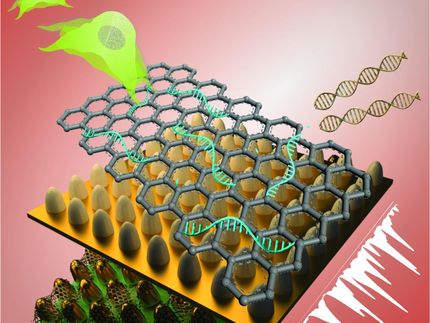
In their study, the working group led by Prof. Dr. Alexey Tarasov shows that a wafer-thin layer of graphene can massively increase the performance of plasmonic biosensors. Such sensors are used to observe interactions between biomolecules, viruses or cells in real time - an important building block for modern medical diagnostics and biomedical research.
The researchers combined a single layer of graphene with so-called surface plasmon resonance (SPR) sensors. This revealed a surprisingly large effect: in various biological tests, graphene amplified the sensor signals by up to 600 percent. The experimentally measured effect is therefore significantly higher than previously published values.
"Our results show that graphene can improve the sensitivity of biosensors significantly more than previously assumed," says Tarasov. "This opens up new possibilities for analyzing biological processes and for future diagnostic applications."
In the experiments, the team investigated the interactions between antibodies and viruses and between peptides and immune cells, among other things. With the improved sensors, it was even possible to distinguish between different cell types - something that was not possible with conventional sensor surfaces.
Such technologies could play an important role in medical research in the future, for example in the development of therapies, the analysis of immune reactions or rapid diagnostic tests directly at the point of treatment.
In addition to Kaiserslautern University of Applied Sciences, the company PROGEN Biotechnik GmbH was also involved in the study as an external partner.
Note: This article has been translated using a computer system without human intervention. LUMITOS offers these automatic translations to present a wider range of current news. Since this article has been translated with automatic translation, it is possible that it contains errors in vocabulary, syntax or grammar. The original article in German can be found here.
Original publication
Ahmar Hasnain, Heiko Heilmann, Nghi Luong Phuong Le, Klaus‐Ingmar Pfrepper, Andreas Wruck, Peter Groß, Bernd Bufe, Alexey Tarasov; "Graphene‐Enhanced Plasmonic Interfaces: A General Strategy for Highly Sensitive Detection of Biomolecular Interactions (Adv. Healthcare Mater. 31/2025)"; Advanced Healthcare Materials, Volume 14, 2025-12-7


Other news from the department science









These products might interest you