Great Ideas: From Stress-Free Cell Sorting to a Universal Flu Vaccine
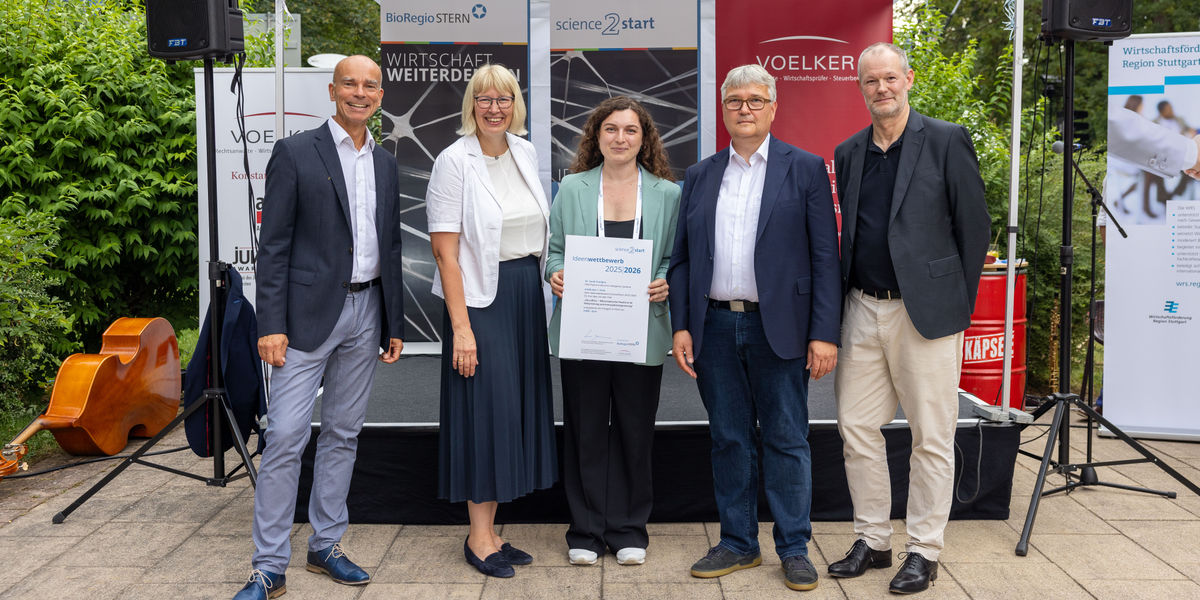
Science2Start 2026: Dr. Sarah Scatigna’s CELLnROLL Wins First Prize
Advertisement


BioRegio STERN Management GmbH’s grand summer reception on July 16, 2026, served as the setting for the annual Science2Start awards ceremony. Four outstanding ideas from scientists were honored: First place went to Dr. Sarah Scatigna from the Max Planck Institute for Intelligent Systems in Stuttgart. She is developing the CELLnROLL technology: On this platform for cell sorting and immunophenotyping, magnetically controllable microrobots identify specific cell types in order to bind to them and sort them automatically. Dr. Dimitri Stowbur from the University Hospital of Tübingen was awarded second prize. Together with his team, he is developing the innovative imaging platform Senova Theranostics. It is designed to make cellular senescence visible in a non-invasive way and make it a target for therapy. Cancer therapies can put tumor cells into a temporary (senescent) dormant state, allowing them to survive treatment and become active again later. Senova Theranostics is designed to specifically detect and eliminate these senescent cells in order to prevent relapses and improve treatment outcomes.
Third place is shared by a team from the University Hospital of Tübingen and Esslingen University of Applied Sciences. In collaboration with Prime Vector Technologies GmbH, the Tübingen team is developing UniFLU-Vacc, a novel vaccine approach against influenza A viruses, with the goal of providing broader and longer-lasting protection than conventional seasonal vaccines. And Kiara Jedele and Christian Höttler from the Faculty of Applied Natural Sciences, Energy, and Building Technology at Esslingen University of Applied Sciences are developing OrgEnX, an energy-positive composting system for food service establishments that processes food waste on-site while generating usable heat.
BioRegio STERN Management GmbH, which this year can already look back on 25 successful years as an economic developer for the life sciences industry, is celebrating its traditional summer reception this time in the shadow of the Stuttgart TV Tower. The event was organized jointly with the Association for the Promotion of Biotechnology and Medical Technology (Verein zur Förderung der Biotechnologie und Medizintechnik e. V.) and in cooperation with the Stuttgart Region Economic Development Corporation. Marjoke Breuning, Honorary Consul of the Kingdom of the Netherlands in Stuttgart, highlighted—as the guest of honor—the long-standing, fruitful collaboration between the Netherlands and BioRegion STERN.
As part of this major regional industry gathering, which drew numerous guests from the worlds of business, science, finance, and politics, the awards ceremony for the 17th Science2Start competition also took place. The competition honors life sciences ideas from the region that, in the opinion of a jury of experts, have particular economic potential. The prize money, totaling 5,500 euros, was traditionally sponsored by Voelker & Partner Attorneys at Law, Tax Advisors, and Certified Public Accountants.
This year’s event was supported, among others, by the Netherlands Business Support Office (NBSO) in Stuttgart. In addition, five hours of patent consulting—provided by WITTE, WELLER & Partner Patentanwälte mbB—were raffled off among all participating guests. TTR Technologie Parks Tübingen-Reutlingen GmbH also participated in the summer reception.
The keynote address was delivered by Dr. Achim Plum, Managing Director of the High-Tech Gründerfonds (HTGF). With more than 20 years of experience in the life sciences industry, he explained: “Stuttgart and the Neckar-Alb region have something that is rare: cutting-edge research, proximity to clinical settings, and a strong industrial base. The key is to translate this potential into tangible results—with a focus on more spin-offs and companies that grow and scale here. The conditions are right. This is a strong foundation for a new, innovation-driven economic miracle originating from this region.”
The Winners of the 2026 Science2Start Competition
1st Place: CELLnROLL: Microrobotic platform for cell sorting and immunophenotyping (Dr. Sarah Scatigna, Max Planck Institute for Intelligent Systems, Stuttgart).
With CELLnROLL, Dr. Sarah Scatigna is developing a new technology for gentle, automated cell sorting that complements existing methods such as MACS and FACS. The current gold standards for isolating specific cells from complex biological samples require large sample volumes, are technically complex, and can damage sensitive cells due to mechanical stress. As a result, many applications involving valuable but limited-availability samples have been feasible only to a limited extent until now.
The CELLnROLL technology is based on magnetically controllable microrobots that specifically recognize and bind to cell types defined by antibodies and sort them automatically using a compact device. This allows cells to be isolated from even very small sample volumes with high purity and without shear stress. By using subpopulations of micro-robots functionalized in different ways, the same process can optionally be performed in parallel for multiple markers, enabling simultaneous multi-marker sorting. Initial validations with clinically relevant samples show sorting purity of approximately 90 percent with significantly lower sample requirements than established methods.
In addition to cell sorting, CELLnROLL is developing an automated immunophenotyping platform designed to enable rapid and standardized analysis of cell characteristics in the future—with potential applications, for example, in the clinical diagnosis of leukemias.
The technology was developed over several years at the Max Planck Institute for Intelligent Systems and at ETH Zurich and forms the basis for the planned spin-off. The goal is to provide a new generation of cell analysis systems for research, biotechnology, and, in the long term, clinical diagnostics.
2nd Place: Senova Theranostics: Senescence Imaging & Targeting (Dr. Dimitri Stowbur, Werner Siemens Imaging Center, Preclinical Imaging and Radiopharmacy, University Hospital Tübingen, as well as Dr. Jonathan M. Cotton, Dr. Francisco J. Reche Pérez, Prof. Dr. Johannes Schwenck, Prof. Dr. Bernd J. Pichler, and Prof. Dr. Lars Zender)
Dr. Stowbur’s team is developing Senova Theranostics, an innovative imaging platform for the non-invasive detection of cellular senescence—a key biological process that plays an important role in conditions such as cancer, age-related diseases, and chronic inflammation. Senescent cells can perform both protective and disease-promoting functions. In tumor diseases in particular, they can influence the effectiveness of therapies and contribute to treatment resistance. However, there is currently no reliable method to quantitatively visualize this process in the human body or to assess the success of new senolytic or senomorphic therapies—that is, treatments that alter the harmful properties of senescent cells without killing them. With SenoScan, Senova Theranostics is developing the world’s first clinically developed PET tracer for the non-invasive visualization of senescent cells. A PET tracer is a radioactively labeled substance used in positron emission tomography to visualize biological processes in the body—in this case, the targeted detection and visualization of senescent cells in the body. A Phase I/II clinical trial currently underway at the University Hospital of Tübingen is investigating the clinical applicability of this approach. Data to date show good tolerability and a correlation between the imaging results and established senescence markers.
Building on SenoScan, the project is developing additional tracers with improved sensitivity, as well as a theranostic concept that combines the targeted identification and, in the future, the elimination of senescent cells. This creates a new approach to precision diagnostics and treatment of senescence-associated diseases.
The technology holds great potential for oncology, particularly as a companion diagnostic in the development and application of senolytic therapies. Furthermore, in the long term, additional applications are opening up for age-related or cardiovascular diseases, fibrosis, and chronic inflammation.
The senescence imaging platform was developed at the Werner Siemens Imaging Center (Prof. Pichler) in close collaboration with the Department of Medical Oncology & Pulmonology (Prof. Zender) at the University of Tübingen and as part of the Tübingen iFIT Cluster of Excellence. The goal is to spin off Senova Theranostics GmbH and translate the technology into clinical and commercial applications.
3rd Place: UniFLU-Vacc: Novel Vaccine Approach Against Influenza A Viruses (Dr. Ralf Amann, Prof. Dr. Oliver Planz, Verena Haug, Carina Metz, Julian Volk, Dr. Melanie Müller, Dr. Felix Pagallies, Clara Krüger, Matthias Helmold, and Annika Schönsiegel, Institute of Immunology, University Hospital Tübingen, in cooperation with Prime Vector Technologies GmbH)
UniFLU-Vacc is a novel vaccine approach against influenza A viruses aimed at providing broader and longer-lasting protection than conventional seasonal vaccines. Despite established vaccination programs, influenza remains a significant public health burden worldwide, particularly because the effectiveness of current vaccines depends heavily on the match between the vaccine and circulating virus variants.
The vaccine candidate takes a universal approach that combines several protective mechanisms: In addition to a broad antibody response against conserved viral structures, it aims to elicit targeted T-cell responses and build local immunity in the respiratory tract. This is intended to improve protection against different influenza A variants and reduce the need for annual vaccine updates.
This approach is made possible by an innovative viral vector-based vaccine technology that allows for the combination of multiple antigen components in a single vaccine design. The “prime-and-pull” vaccination concept combines a systemic primary immunization with an intranasal booster to elicit an immune response both throughout the body and directly at the site where the virus enters the respiratory tract. It is thus a two-stage vaccination principle in which, first, a classic “prime” vaccination activates the immune system throughout the body, resulting in a systemic immune response involving antibodies and T cells. Subsequently, the “pull” component directs the immune response specifically to the site of entry of the pathogen—such as the mucous membranes of the respiratory tract—and strengthens it locally there.
Initial preclinical studies show that UniFLU-Vacc can elicit broad antibody and T-cell responses against various influenza A subtypes. In animal models, a reduced viral load, milder disease symptoms, and improved protection compared to conventional influenza vaccines were observed.
The project is based on the ORFV vaccine platform from Prime Vector Technologies GmbH, the influenza expertise of Prof. Dr. Oliver Planz’s research group, and the vaccine expertise of Dr. Ralf Amann’s research group at the University Hospital of Tübingen. The goal is to advance the project to clinical trials and to transition the vaccine candidate into an independent development structure. In the long term, UniFLU-Vacc has the potential to contribute to the development of broadly effective influenza vaccines and to better preparedness for future pandemics.
3rd Place: OrgEnX: Energy-Positive Composting Facility (Kiara Jedele and Christian Höttler, Faculty of Applied Natural Sciences, Energy, and Building Technology at Esslingen University of Applied Sciences)
OrgEnX aims to develop a compact, energy-positive composting system for food service establishments that processes food waste directly on-site while simultaneously generating usable heat. The goal is to significantly reduce disposal costs, energy consumption, and emissions associated with food waste management.
Restaurants, hotels, and cafeterias regularly generate large quantities of food waste, the disposal of which currently involves high costs and logistical challenges. While existing decentralized composting systems can reduce waste volume, they require a lot of energy and often produce only unstable pre-compost that must subsequently undergo further treatment.
OrgEnX technology specifically harnesses the natural biological degradation process to generate energy. Thanks to an innovative reactor design with optimized oxygen supply and heat management, the system generates the necessary process heat itself and can also provide additional heat for the food service operation. This results in the first composting system that generates more energy than it requires for operation.
In addition to the efficient processing of food waste, the system enables higher-quality compost, automated process control, and digital functions for monitoring and documenting waste volumes. In this way, OrgEnX supports food service and hotel businesses in meeting rising sustainability requirements and future regulatory standards.
The technology was developed by Christian Höttler and Kiara Jedele and is based on scientific research into the biological recycling of food waste and energy generation from biomass. Initial technical tests and customer discussions confirm the potential of this approach. The goal is to develop a scalable system for the food service and hospitality industries that combines waste management, energy efficiency, and the circular economy.
Note: This article has been translated using a computer system without human intervention. LUMITOS offers these automatic translations to present a wider range of current news. Since this article has been translated with automatic translation, it is possible that it contains errors in vocabulary, syntax or grammar. The original article in German can be found here.


Other news from the department science







Most read news





More news from our other portals













Something is happening in the life science industry ...
This is what true pioneering spirit looks like: Plenty of innovative start-ups are bringing fresh ideas, lifeblood and entrepreneurial spirit to change tomorrow's world for the better. Immerse yourself in the world of these young companies and take the opportunity to get in touch with the founders.