Logistics master in the cell: researchers decode the "navigation system" for mRNA
Work honored as breakthrough manuscript: Findings could enable further development of mRNA vaccines
Advertisement


Just like in a giant factory, components in living cells must arrive at the right place at the right time. A research team led by Heinrich Heine University Düsseldorf (HHU) has investigated how the transport protein Rrm4 acts as a high-precision logistician in the fungus Ustilago maydis. The work was published as a "breakthrough manuscript" in the journal Nucleic Acids Research (NAR) due to its significance.
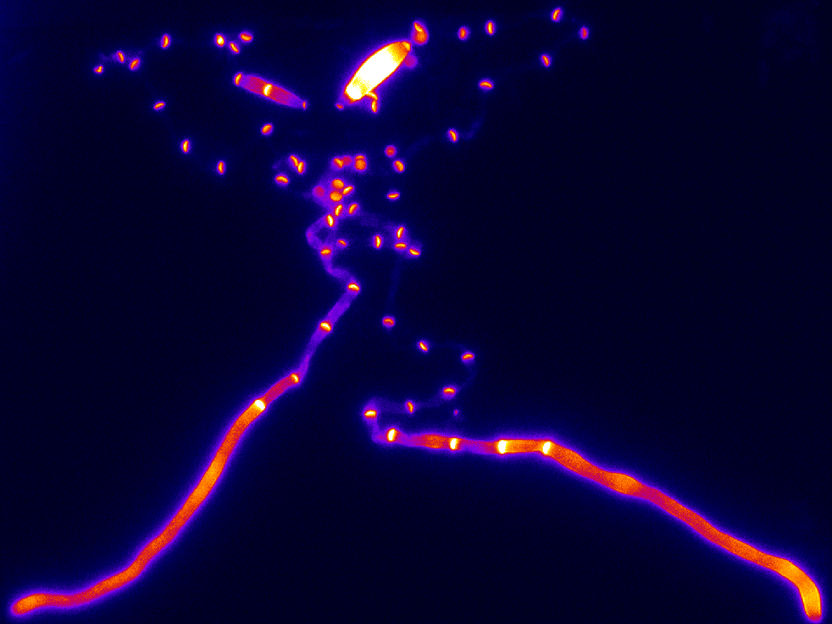
Fluorescence microscope image of Ustilago maydis hyphae with unipolar growth and septation: cytoplasm, septa and initial cell are stained with the dye Calcofluor White, which makes chitin of the fungal cell wall visible.
HHU / Johannes Postma & Michael Feldbrügge
Inside every cell, the blueprint of life - the DNA - is well protected in the cell nucleus. In order to produce proteins - the tools of the cell - a copy of the blueprint is created: the so-called "messenger RNA" (mRNA for short). This must then be transported to where the cell needs it, for example to the protein factories.
In the case of Ustilago maydis, which causes the fungal disease "corn smut" in maize, the mRNAs have to be transported over long distances to the outermost tips of its thread-like extensions (the "hyphae"). Transport processes and their control therefore play a central role in the functioning of the cells. An active express transport service is required to reach distant locations.

In Ustilago maydis, the transport protein Rrm4 takes on this logistical task. It has three specialized "gripper arms" (so-called RRMs; RNA recognition motifs) with which it grabs the mRNA and loads it onto membrane-enclosed organelles (endosomes). These act like freight cars that race along the microtubules through the cell as if on rails.
But how does the transport protein recognize which mRNAs it needs to grab? Using the high-precision iCLIP2 method, the researchers led by Prof. Dr. Michael Feldbrügge from the HHU Institute of Microbiology showed that the mRNA has specific "zip codes" (quasi postal codes). Only if the protein's gripper arm fits exactly into this zipcode is the package loaded correctly and - just as importantly - kept stable en route.
"Understanding this process in detail was only possible by closely interlinking the disciplines. While the experimental biologists in the laboratory in Düsseldorf examined the fungi and analyzed mutations, computer biologists from Würzburg dealt with the enormous complexity of the data. It was only through computer-assisted analysis that the millions of binding points between protein and RNA could be decoded and the functionally important binding sites identified," says Prof. Feldbrügge, corresponding author of the study published in NAR, explaining the interaction between the various cooperation partners. He adds: "In this way, we decoded the function of the Rrm4 protein at a previously unattained high resolution. Our approach can also be used for a large number of other proteins."
The researchers found that each of the three gripping arms has a different task in recognizing the mRNA. Binding not only determines transport, but also how long an mRNA lasts before it is degraded. By specifically "switching off" individual gripper arms, it was shown that without precise binding, the entire logistics of the cell collapse - the fungus can no longer grow normally.
A particular focus of the work was on mRNAs that are destined for the mitochondria (the cell's power plants). They are dependent on a constant supply of mRNAs. The researchers have now succeeded in understanding how the nucleus, endosomes and mitochondria communicate with each other.
Intracellular networking is a core issue of the Düsseldorf Collaborative Research Center SFB 1535 MibiNet, within the framework of which the investigations were carried out. "We have now understood how the cell ensures that the energy supply and communication between the different cell areas function smoothly through the targeted transport of mRNA," says Prof. Feldbrügge, spokesperson of the CRC.
These results of basic research on a fungus also have far-reaching implications for modern medicine. Prof. Feldbrügge on possible further perspectives: "If it is clear how mRNA is transported, recognized and stabilized, mRNA vaccines - which are known from the corona pandemic - can be further developed, made more precise and more effective on this basis, for example."
The work was recognized by the journal NAR as a so-called breakthrough manuscript. This shows the special significance of the study: only the best two percent of the papers submitted receive such an award.
Note: This article has been translated using a computer system without human intervention. LUMITOS offers these automatic translations to present a wider range of current news. Since this article has been translated with automatic translation, it is possible that it contains errors in vocabulary, syntax or grammar. The original article in German can be found here.
Original publication


Other news from the department science