Snap fastener instead of a weld: targeted binding and release of bioactive compounds
New biosynthesis platform could enable bioactive compounds to be labeled, targeted and released on demand
Advertisement


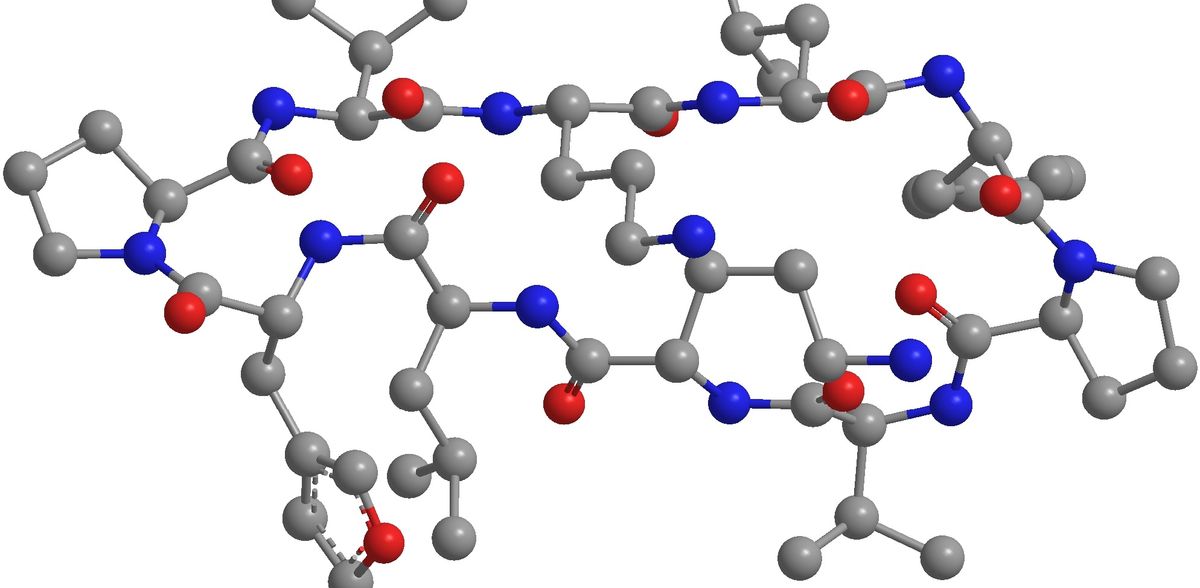
A research team at the Leibniz Institute for Natural Product Research and Infection Biology (Leibniz-HKI) in Jena, in collaboration with the University of Jena, has successfully biosynthesized a natural product containing a reactive chemical group. The furan moiety of the amino acid furylalanine enables the reversible attachment of fluorescent dyes to peptides such as antibiotics, for example. The study was recently published in the science journal »Chem«.
Many medically important drugs originate from natural sources. Microorganisms produce these compounds using highly sophisticated and remarkably precise enzymatic assembly lines. Many microbial natural products belong to a class known as nonribosomal peptides—short chains of amino acids that often possess pharmacologically relevant biological activities, including antibiotic effects. Unlike ordinary proteins, they are not synthesized by ribosomes but by enzymatic »assembly lines« that link molecular building blocks together step by step.
»Our goal was to introduce chemically reactive groups into such nonribosomal peptides so that further reactions could later be performed at these sites,« explains Friedrich Ehinger, first author of the study.
The researchers have now developed a platform technology that allows reactive groups to be integrated into natural products through de novo biosynthesis. In other words, the engineered bacteria can produce all molecular building blocks for the bioactive peptide themselves. A specialized enzyme enables the bacteria to convert the amino acid tyrosine into furylalanine. Another major challenge was to ensure that microorganisms incorporated these reactive group into natural products at precisely defined positions. Using directed evolution, the researchers modified peptide synthetases so that they preferentially incorporate furylalanine instead of their natural substrate phenylalanine into the peptide structure.
As a result, the antibiotic synthesized by the bacterium contains a furan moiety that acts as a reactive handle to which other molecules can be selectively attached. This is achieved through a so-called Diels-Alder reaction. Put simply, two matching chemical structures form a ring together. This makes it possible, for example, to attach fluorescent dyes and visualize the molecule microscopically at its site of action. Coupling the molecule to antibodies, on the other hand, could allow it to be directed specifically to a desired target site—potentially increasing efficacy while reducing unwanted side effects.
A snap fastener principle
»What is new about our method is that it works like a snap fastener,« emphasizes Christian Hertweck, Head of the Department of Biomolecular Chemistry at Leibniz-HKI and Professor at Friedrich Schiller University Jena. »It allows two molecules to be connected in a highly controlled way, but also separated again when needed.«
The newly developed method is highly versatile. Bioactive peptides can not only be labeled with other molecules, but also selectively enriched from mixtures and subsequently released again. Another possible application is to immobilize a bioactive peptide—such as the antibiotic gramicidin S used in this study—on a carrier material and release it gradually through body heat, similar to drug-containing patches.
Side effects disappear
Unexpected discoveries and attentive observation are often powerful drivers of scientific progress. Initially, the authors were pleased that the antibiotic activity of gramicidin S was not diminished by the modification. However, they also observed that the undesirable side effects of gramicidin S almost completely disappeared in the furylalanine-containing variant. Thus, the structural change introduced by incorporating furylalanine may itself offer important advantages.
»Gramicidin S was originally just our test system for evaluating the method,« says Hertweck. »But we realized that modifying the molecule also improved its pharmacological properties.« »Gramicidin S is usually applied only topically, for example against acne, because it destroys red blood cells upon direct contact,« Ehinger adds. »In our experiments, we observed that the modified antibiotic was no longer hemolytic under biologically relevant conditions.« The new compound was successfully tested against multidrug resistant pathogens such as MRSA during the study.
The findings and the platform technology developed in this work could become highly relevant for future biomedical research and medical applications. That is why a patent application has been filed for the technology.
A Collaborative Effort
Ehinger and Hertweck emphasize that the study was carried out as an international collaborative effort involving several research groups. In addition to Leibniz-HKI, researchers from the Universities of Jena, Halle, and Stuttgart, as well as the Mexican research institute CINESTAV, contributed to the work. Funding was provided by the Jena Cluster of Excellence »Balance of the Microverse« and the DFG Collaborative Research Center ChemBioSys.
Original publication


Other news from the department science