Protein inhibition can weaken leukemia cells
Researchers were able to trigger targeted defense reactions and cell death in cancer cells
Advertisement


In a study conducted by the Mainz University Medical Center, cancer cells in acute myeloid leukemia were specifically weakened by a newly discovered mechanism. The inhibition of certain proteins that influence gene activity triggered a strong immune response in the cancer cells. This immune response resembled that of influenza, weakened the tumor cells and could trigger their cell death. The researchers were even able to enhance this effect with immunostimulatory messenger substances. In the long term, the results could contribute to the development of a new, targeted combination therapy for acute myeloid leukemia. The results were published in the journal Blood.
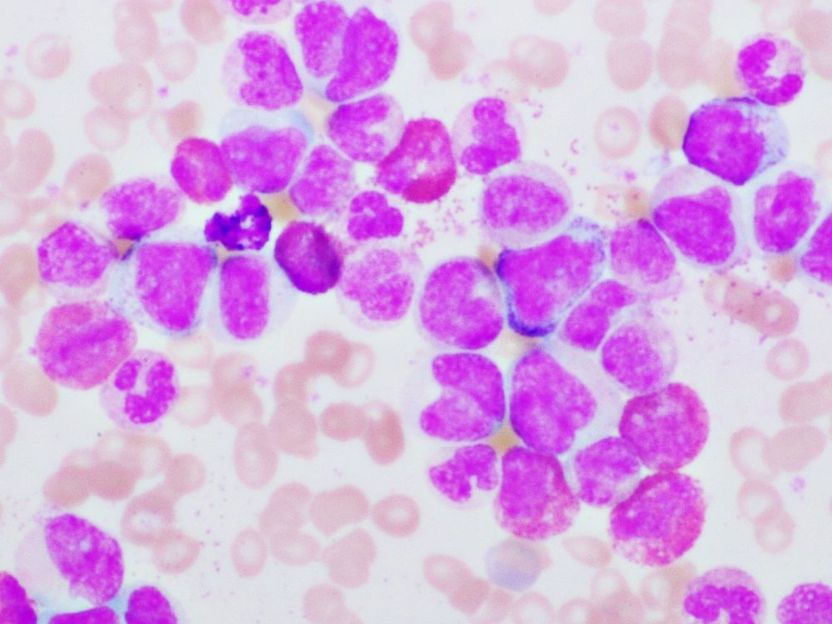
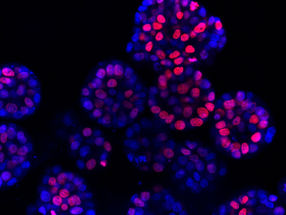
Microscopic image of cancer cells of acute myeloid leukemia (400x magnification)
Copyright: UM/Canva
Acute myeloid leukemia (AML) is an aggressive form of blood cancer. It develops when precursor cells of blood cells multiply uncontrollably in the bone marrow, where blood cells are formed. These non-functional cells displace the healthy blood cells, resulting in a shortage of blood cells and platelets. As a result, oxygen transport, blood clotting and the immune defense function only to a limited extent.
A research team led by Dr. Daniel Sasca, Head of Personalized Hematology and Medical Oncology at the Department of Medicine III of the Mainz University Medical Center, has investigated how the inhibition of the two proteins p300 and CBP affects tumor cells. These two proteins act like control centers and control which genes are switched on and off in a cell.
Until now, researchers have assumed that the inhibition of p300 and CBP generally attenuates the activity of genes. However, the results of the study "Inhibition of p300/CREBBP catalytic activity drives context-dependent transcriptional activation in AML" showed the opposite: in some of the cancer cells, the protein inhibition switched on certain defense programs. This in turn activated genes that are normally involved in the immune defense against viral infections. This immune response caused the cancer cells to stop growing, change and eventually die. "We see a kind of false alarm inside the cancer cells," explains Dr. Sasca, who led the study. "The tumor cells get a severe flu from our therapy and die as a result."
The researchers were even able to specifically enhance this effect: In combination with interferon-alpha, an endogenous antibody against viruses and tumors, the cancer cells reacted particularly sensitively. Both in cell cultures and in animal models, the combination therapy had a significantly stronger effect against leukemia.
The researchers investigated this mechanism at several levels of gene regulation simultaneously: from gene activity and protein changes to the DNA-protein complex. The researchers used modern biochemical analysis methods, such as single cell examinations, proteome analyses and genetic test procedures. This enabled the scientists to observe the reaction of the leukemia cells to the inhibition of p300 and CBP from several angles simultaneously. The results of this basic research could open up new perspectives for the treatment of acute myeloid leukemia - in the form of new combination therapies that use the targeted "self-defense" of the cancer cells.
The translational research work is funded as part of the Emmy Noether Program of the German Research Foundation (DFG). As part of the Collaborative Research Center 1292, scientists from the Mainz University Medical Center and external cooperation partners in Frankfurt, Greifswald and Cambridge are investigating the causes of inefficient immune responses in tumors and chronic infections with the aim of developing new immunotherapeutic therapies.
Note: This article has been translated using a computer system without human intervention. LUMITOS offers these automatic translations to present a wider range of current news. Since this article has been translated with automatic translation, it is possible that it contains errors in vocabulary, syntax or grammar. The original article in German can be found here.
Original publication
Markus Meyerhöfer, Yawen Zhou, Aaron Gallego-Crespo , Viral Shah, Malte Behrendt, Maria Saura-Pañella, Björn Häupl, Oleksandr Todoriuk, ... George Vassiliou, Brian Huntly, Michael Kühn, Falk Butter, Thomas Oellerich, Daniel Sasca. Inhibition of p300/CREBBP catalytic activity drives context-dependent transcriptional activation in AML, Blood (2026)


Other news from the department science