Scientists produce first open source all-atom models of full-length COVID-19 'S' protein

The protein structure facilitates viral entry into host cells making it a key target for vaccine and antiviral drug development

23-Jun-2020 - USA

The virus SARS coronavirus 2 (SARS-CoV-2) is the known cause of coronavirus disease 2019 (COVID-19). The "spike" or S protein facilitates viral entry into host cells.
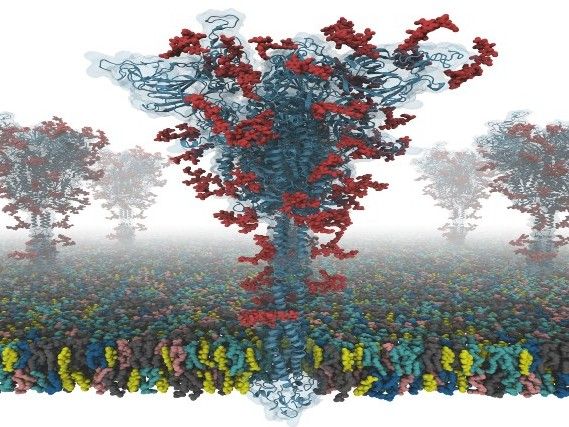
Dr. Yeolkyo Choi/Lehigh

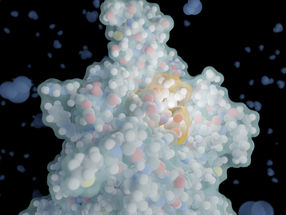
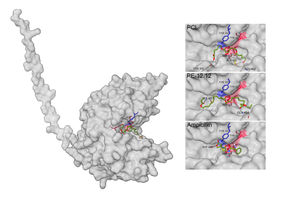
A model of an S-protein.

Now a group of researchers from Seoul National University in South Korea, University of Cambridge in UK, and Lehigh University in USA, have worked together to produce the first open-source all-atom models of a full-length S protein. The researchers say this is of particular importance because the S protein plays a central role in viral entry into cells, making it a main target for vaccine and antiviral drug development.

The details can be found in a paper , "Developing a Fully-glycosylated Full-length SARS-CoV-2 Spike Protein Model in a Viral Membrane" just published online in The Journal of Physical Chemistry B.
A video demo illustrates how to build this membrane system from their SARS-CoV-2 S protein models. The model-building program is open access and can be found from the home page of CHARMM-GUI by clicking on the COVID-19 Archive link.

Developed by Wonpil Im, a professor in Lehigh University's Department of Biological Sciences and Bioengineering Department, CHARMM-GUI (GUI = graphical user interface) is a program that simulates complex biomolecular systems simply, precisely and quickly. Im describes it as a "computational microscope" that enables scientists to understand molecular-level interactions that cannot be observed any other way.

"Our models are the first fully-glycosylated full-length SARS-CoV-2 spike (S) protein models that are available to other scientists," says Im. "I was fortunate to collaborate with Dr. Chaok Seok from Seoul National University in Korea and Dr. Tristan Croll from University of Cambridge in the U.K. Our team spent days and nights to build these models very carefully from the known cryo-EM structure portions. Modeling was very challenging because there were many regions where simple modeling failed to provide high-quality models."

Scientists can use the models to conduct innovative and novel simulation research for the prevention and treatment of COVID-19, according to Im.

The S protein structure was determined with cryo-EM with the RBD up (PDB ID: 6VSB), and with the RBD down (PDB ID: 6VXX). But, this model has many missing residues. So, they first modeled the missing amino acid residues, and then other missing domains. In addition, they modeled all potential glycans (or carbohydrates) attached to the S protein. These glycans prevent antibody recognition, which makes it difficult to develop a vaccine. They also built a viral membrane system of an S protein for molecular dynamics simulation.

Original publication
Other news from the department science
Most read news

More news from our other portals

So close that even
molecules turn red...

Last viewed contents

In the heat of the wound - Smart bandage

In the heat of the wound - Smart bandage

Sartorius opens new Center of Excellence for bioanalytics in Ann Arbor - Manufacturing of instruments, consumables and reagents for cell and protein analysis

Sartorius opens new Center of Excellence for bioanalytics in Ann Arbor - Manufacturing of instruments, consumables and reagents for cell and protein analysis

CyBio and Macherey-Nagel collaborate to develop applications for automated DNA/RNA preparation

Innovations for Health: When Molecular Spectroscopy Meets Lasers and Photonics - "An all-optical, minimally invasive and label-free diagnostic tool could represent a significant advance in health..."

Innovations for Health: When Molecular Spectroscopy Meets Lasers and Photonics - "An all-optical, minimally invasive and label-free diagnostic tool could represent a significant advance in health..."

HI viruses crack the lock to the cell nucleus - For the first time, researchers have observed how HIV penetrates the nuclear pores to the genome of human immune cells

HI viruses crack the lock to the cell nucleus - For the first time, researchers have observed how HIV penetrates the nuclear pores to the genome of human immune cells

Closure of Astellas CNS research in Edinburgh

Antibody discovered that blocks almost all known HIV variants in neutralization assays - The discovery potentially opens up new perspectives for the prevention and treatment of HIV infections

Antibody discovered that blocks almost all known HIV variants in neutralization assays - The discovery potentially opens up new perspectives for the prevention and treatment of HIV infections

New method for measuring luminescence lifetime offers breakthrough in scientific imaging - Ac­cel­er­at­ing the pace of dis­cov­ery in sci­ence and in­dustry

New method for measuring luminescence lifetime offers breakthrough in scientific imaging - Ac­cel­er­at­ing the pace of dis­cov­ery in sci­ence and in­dustry

Decreasing biodiversity may promote spread of viruses - New insight into the dynamics of infectious disease

Decreasing biodiversity may promote spread of viruses - New insight into the dynamics of infectious disease

Mysthera Therapeutics Launches to Develop First-in-Class Autoimmune Disease Therapies - Seed Capital from Forty51 Ventures to Advance Pipeline of Pan-PIM Kinase Inhibitors

Mysthera Therapeutics Launches to Develop First-in-Class Autoimmune Disease Therapies - Seed Capital from Forty51 Ventures to Advance Pipeline of Pan-PIM Kinase Inhibitors

3D-printed pills with desired drug release – a step upwards in medication - Funny looking pills are not a design gimmick, they can release medication in a desired time regime!

3D-printed pills with desired drug release – a step upwards in medication - Funny looking pills are not a design gimmick, they can release medication in a desired time regime!

Coronavirus SARS-CoV-2 spreads more indoors at low humidity - Indian-German research team recommends at least 40 percent humidity in public buildings

Coronavirus SARS-CoV-2 spreads more indoors at low humidity - Indian-German research team recommends at least 40 percent humidity in public buildings