Startup Project: Through the Gate to the Heart
Heart pump without a heart-lung machine: Freiburg team develops new implantation procedure
Advertisement


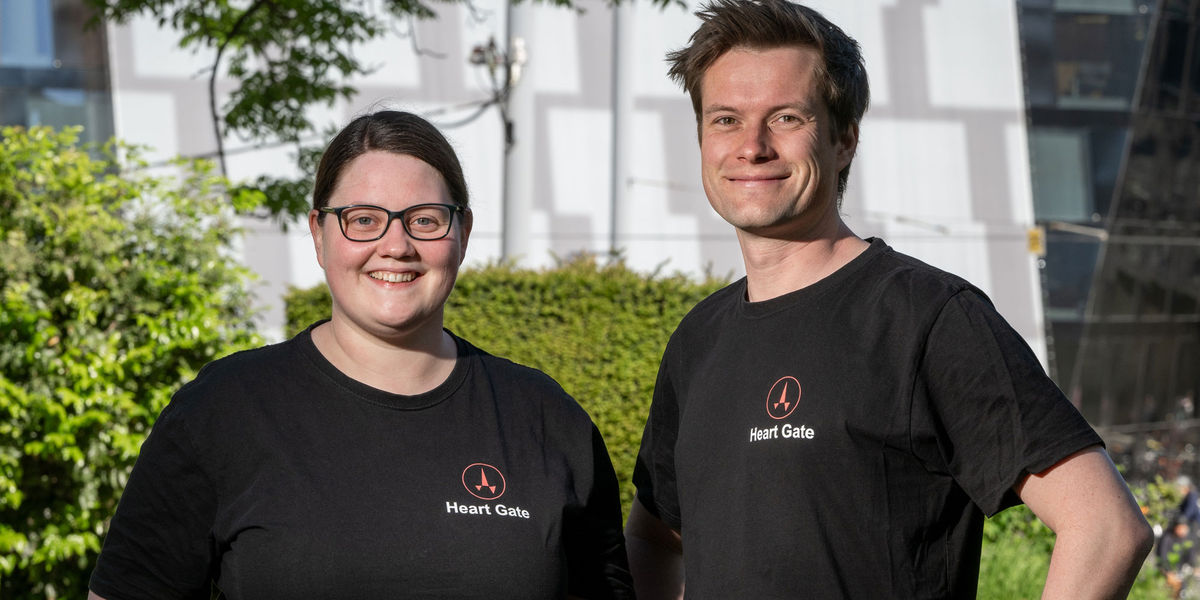
Making heart operations safer, faster, and more cost-effective – that is the aim of HeartGate, a startup project by a team of researchers from the University of Freiburg’s Faculty of Medicine. Their initiative is now regarded as a flagship project receiving millions of euros in funding, but the road to get there was not an easy one.
“When the heart is too weak to provide the body with a sufficient supply of blood, a heart transplant is often the last resort. But as there are too few people willing to donate organs, mechanical heart pumps are used as an alternative”, says Manuela Schön . The medical technology engineer is sitting in front of a plastic anatomical heart model and holding a heart pump at its tip.
The pump is somewhat larger than a golf ball. It weighs 200 grams and feels heavier in one’s hand than expected. Protruding from it is a hollow cylinder about 2 cm in diameter, called the ‘inflow’. It allows blood to flow into the pump. “To insert the inflow into the ventricle, it is necessary to punch a hole into the wall of the heart”, explains Schön. “If this were to be done on a beating, blood-filled heart, there would be a risk of life-threatening bleeding.”
Heart pumps are thus used in conjunction with a heart-lung machine, which diverts the blood flow around the heart during the operation. “But that also entails risks for the patient. It is a major, lengthy operation that is very expensive”, says Schön. That is why she, the physician Dr Florian Meißner , and their team are developing a procedure to enable the heart pump to be implanted in future without the need for a heart-lung machine. The name of the project is HeartGate.
An unplanned outing in Hinterzarten that changes everything
The team came up with the idea during an outing to a partner organization in Stuttgart. The organization had to cancel the appointment at short notice, and the group were already in the car. Instead of driving to their planned destination, they stopped off in Hinterzarten. “We sat down in a cafe together and discussed work, as we often do. That’s when we struck on the idea: Wouldn’t it be great if it were possible to implant heart pumps without heart- lung machines? How could this be achieved from a technical standpoint?”, says Schön.
Die Idee entsteht 2023 bei einem abgebrochenen Teamausflug zu einem Kooperationspartner in Stuttgart. Dieser muss den Termin spontan absagen, da sitzt die Gruppe schon im Auto. Statt zum geplanten Ziel zu fahren, machen sie Halt in Hinterzarten. „Wir saßen dann in einem Café zusammen und haben uns, wie so oft, über die Arbeit unterhalten. Da kam die Idee auf: Wir würden Herzpumpen am liebsten ohne Herz-Lungen-Maschinen implantieren – wie könnte man das technisch umsetzen?“, so Schön.
The unplanned outing in Hinterzarten came at a time in 2023 when the team was not really in the mood for a leisurely cup of coffee. Up to that point, they had been working on an adapter for heart pumps within the YCOR project, but an application they had submitted for EXIST funding had recently been turned down. The team’s third-party funding was coming to an end, and the researchers faced a difficult decision: Should they pursue their current idea further or embark on a new project? It was in this challenging situation that the idea for HeartGate was born.
What started out as a thought experiment soon turned into something more. The team produced initial designs, built models, tested prototypes, and submitted two invention disclosures to the University’s transfer office, which were filed as patents in 2024.
But this project would require funding as well. And for this project too, an application for EXIST funding from the federal government was initially rejected following the patent filing. ‘It was not an easy time’, remembers Meißner. “Our funding had run out again, and we didn’t know how to proceed”. During this period of uncertainty, in March 2025, he took to the stage for the first time to pitch his project – and won the audience award at Innovation Night in Rottweil. “The pitch was an initial success. Now it was clear: Okay, there are people who think what we’re doing is great and believe in our project”, says Meißner.
These initial successes provided motivation for an important appointment in Berlin: The team was invited to present their research project to a jury from GO-Bio next, a funding programme sponsored by the Federal Ministry of Research for startup projects in the life sciences. The University of Freiburg’s Startup Office advised the team on preparing their pitch. “We received some very constructive feedback from the Startup Office on our pitch deck, which was incredibly helpful”, says Meißner.
These initial successes provided motivation for an important appointment in Berlin: The team was invited to present their research project to a jury from GO-Bio next, a funding programme sponsored by the Federal Ministry of Research for startup projects in the life sciences. The University of Freiburg’s Startup Office advised the team on preparing their pitch. “We received some very constructive feedback from the Startup Office on our pitch deck, which was incredibly helpful”, says Meißner.
In the same month, the team received more good news: Schön had been awarded a grant in the Startup|Women programme, with which the University of Freiburg supports women with business ideas and provides them a year of guidance. “I benefited most of all from the extensive network that the programme provided me with”, says Schön. She received a personal mentor, an employee at the Freiburg innovation platform BadenCampus, which collaborates closely with the University of Freiburg’s Startup Office. “The University’s partnership with BadenCampus helped us with startup-related issues. This gave us access to topics like funding and marketing, which we, as researchers, were not yet very familiar with back then”, says Schön.
A pitch in Berlin that leads to the breakthrough
The pitch in Berlin led to the breakthrough: HeartGate received approval for 4.35 million euros in funding. Today the team is working on developing their idea into a marketable medical product. Meißner and Schön are doing everything they can to make this possible. They continue to pitch and are winning one prize after the other – including first place at the Science4Life Venture Cup, Germany’s largest business plan competition in the life sciences. Alongside their work in the lab, they are pursuing master’s degrees part time at Furtwangen University in the fields of ‘Medical Devices & Healthcare Management’ and ‘Regulatory Affairs’.
What keeps the two motivated? The fun they have within their team, the fact that they are constantly learning, and also the people they never would have met if it had not been for the project: including inspiring entrepreneurs with fascinating business stories as well as political decision-makers such as Martin Horn, Cem Özdemir, and Dorothee Bär. More than anything else, however, it is the potential benefit for patients: “There’s a chance that HeartGate will make the current surgical procedure safer and quicker”, says Meißner. “If we don’t try it out, we’ll never find out whether it works. We believe in our idea.”


Other news from the department business & finance







Most read news





More news from our other portals











Something is happening in the life science industry ...
This is what true pioneering spirit looks like: Plenty of innovative start-ups are bringing fresh ideas, lifeblood and entrepreneurial spirit to change tomorrow's world for the better. Immerse yourself in the world of these young companies and take the opportunity to get in touch with the founders.