Silicon Valley biotech company Phinomics is expanding into Europe and launching at Bayer Co.Lab Berlin
The company is integrating its “Deep Biology” platform with one of Europe’s leading translational research ecosystems.
Advertisement


Phinomics has announced that it has selected the Bayer Co.Lab Berlin as the base for its European expansion. This marks the company’s first international presence since emerging from stealth mode.
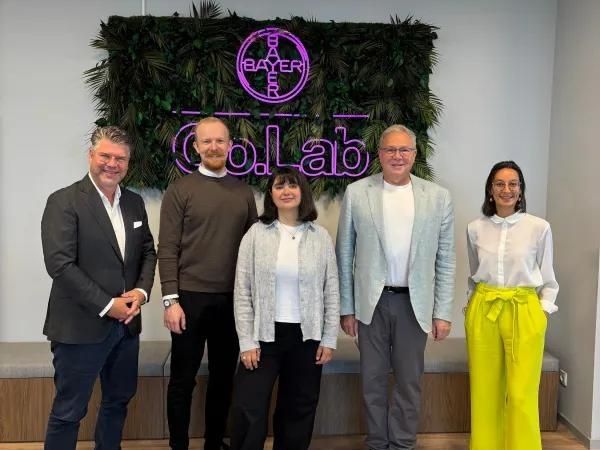
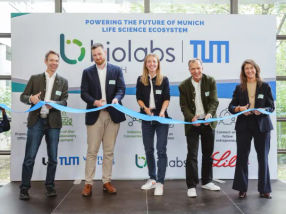
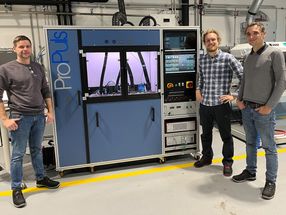
From left to right: Guido Mathews, Simon Cladder, Massa Shoura, Stephen Levene, Ruth Shah
© Simon Cladders
Admission to the Bayer Co.Lab is highly competitive: It is not an open-access incubator; rather, Bayer accepts only a small, hand-picked cohort of companies that demonstrate groundbreaking scientific and commercial potential. By selecting Phinomics, the company is positioning its platform alongside leading clinical, academic, and pharmaceutical partners in one of Europe’s fastest-growing life sciences ecosystems. The goal is to establish pharmaceutical collaborations to further advance AI-driven oncology drug discovery in particular.
Phinomics has developed a proprietary deep-biology multi-omics platform based on extrachromosomal circular DNA—the so-called circulome. These genetic elements, which exist outside the standard chromosomal genome, are increasingly recognized as key drivers of tumor development, oncogenesis, and drug resistance, and are associated with at least half of all cancers. Although their role in cancer progression and phenotypic evolution has been documented for decades, their clinical application has so far been blocked by a complex technological barrier. These ranged from isolation chemistry to the signal-to-noise ratio in sequencing to the lack of suitable computational tools to decode them precisely.
Using its patented direct isolation methods, Phinomics captures the circulome with 100 times higher sensitivity and resolution than conventional sequencing approaches. This data is then integrated with genomic, transcriptomic, epigenetic, and proteomic data from paired tumor and healthy tissue samples from the same patient. By integrating this previously “hidden layer” of cancer biology into a unified multi-omic knowledge graph —combined with explainable AI—Phinomics aims to uncover disease mechanisms and therapeutic targets that have been overlooked by conventional approaches based on fragmented or single data types.
The clinical relevance of this “hidden layer” is increasingly supported by recent research findings. Pioneering work co-authored by the founders of Phinomics—including the first version of their genome-wide method for isolating and mapping circular DNA (2017) [1] as well as a clinical concept on the role of eccDNA in tumor heterogeneity and resistance (2020) [2]—have, together with a rapidly growing number of independent studies, established circular DNA as a central and clinically significant feature of cancer. Phinomics was founded with the goal of making this aspect visible right from the start of drug discovery, rather than only after resistance has already emerged.
“The next frontier in AI-driven drug discovery lies in the diversity and completeness of the data. Today’s models can only learn from the biology that we are actually able to measure. Scaling alone does not solve this problem: even a trillion measurements of a single, narrowly defined level leave a model blind to the rest of the system. For decades, a crucial level of cancer biology has remained invisible because conventional sequencing workflows cannot capture extrachromosomal DNA. This is exactly where Phinomics comes in: We capture the circulome and integrate it with orthogonal molecular data from the same biological sample. This yields a significantly more complete and biologically consistent picture of the underlying mechanisms. In this way, we uncover the deep mechanistic and regulatory pathways that drive disease,” explains Dr. Massa Shoura, founder and CEO of Phinomics. “To further develop our platform, we need more than just lab space. We need an environment where advanced AI, translational science, and clinical research converge. The Bayer Co.Lab Berlin is located precisely at this intersection. Being part of Berlin’s life sciences ecosystem enables us to collaborate closely with clinicians, researchers, and industry partners to translate previously hidden biological relationships into the next generation of oncology therapies.”
Note: This article has been translated using a computer system without human intervention. LUMITOS offers these automatic translations to present a wider range of current news. Since this article has been translated with automatic translation, it is possible that it contains errors in vocabulary, syntax or grammar. The original article in German can be found here.
Original publication
Massa J Shoura, Idan Gabdank, Loren Hansen, et al.; "Intricate and Cell Type-Specific Populations of Endogenous Circular DNA (eccDNA) in Caenorhabditis elegans and Homo sapiens"; G3 Genes|Genomes|Genetics, Volume 7, 2017-10-1
C. Bailey, M.J. Shoura, P.S. Mischel, et al.; "Extrachromosomal DNA—relieving heredity constraints, accelerating tumour evolution"; Annals of Oncology, Volume 31


Other news from the department business & finance