Fatal mix-up: How certain intestinal bacteria drive multiple sclerosis
Advertisement


If intestinal bacteria resemble the protective layer of nerves too closely, they can misdirect the immune system and drive it to attack its own nervous system. This mechanism can accelerate the progression of multiple sclerosis, as researchers at the University of Basel have shown in experiments with mice. However, their findings also open up opportunities for therapies that make use of the microbiome.
When the immune system confuses friend and foe, autoimmune diseases develop. In multiple sclerosis (MS), it mistakenly attacks the body's own protective sheath of nerve fibers, the so-called myelin sheath. Those affected experience fatigue and numbness in their limbs, for example, and develop problems with walking and even paralysis.
Researchers have been investigating the question of how this fatal error in the immune system occurs for decades. More recent hypotheses also focus on the intestinal flora. This is because people with MS have a different composition of microorganisms in their gut than people without the disease.
"We know that the intestinal flora influences the immune system, but the mechanisms in relation to MS are not fully understood," says Prof. Dr. Anne-Katrin Pröbstel from the Universities of Basel and Bonn. With her research group at the University of Basel and the University Hospital Bonn, the neurologist is investigating the role of the microbiome in MS.
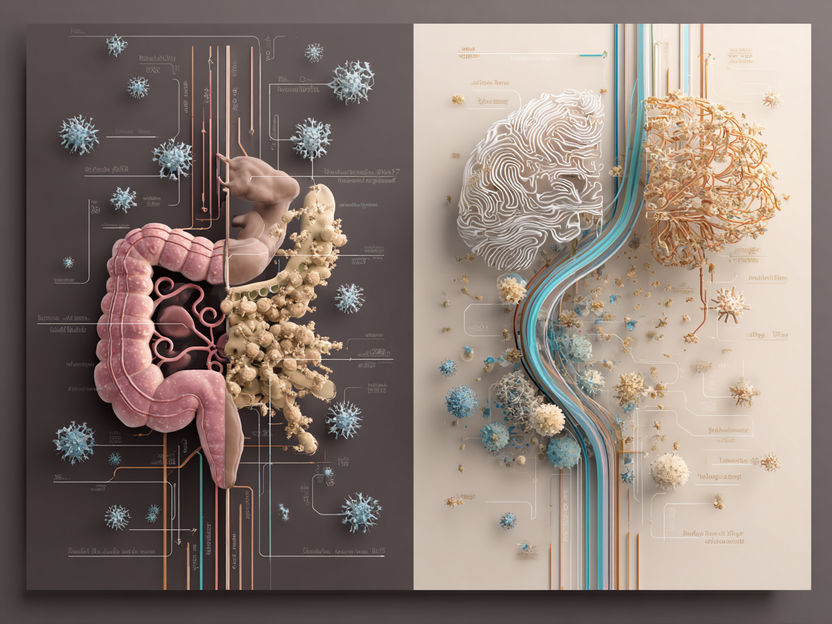
Symbol image
AI-generated image
Dangerous doppelgangers
One hypothesis is that inflammation-promoting intestinal bacteria, which have similar surface structures to the myelin layer of the nerves, stir up the immune system: The immune cells then attack both the harmful bacteria and the body's own myelin layer. Experts refer to this similarity between the bacteria and the myelin layer as "molecular mimicry".
In a study published in the journal "Gut Microbes", Pröbstel's research team and first authors Dr. Lena Siewert and Dr. Kristina Berve provide new evidence for this hypothesis. Using molecular biological methods, they modified pro-inflammatory Salmonella bacteria so that they have a surface structure similar to the myelin layer. They used the unmodified bacteria of the same species as a control.
In genetically modified mice, which can serve as a disease model for MS, the myelin-like Salmonella bacteria caused the disease to progress significantly faster than the unmodified bacteria. "The pro-inflammatory bacteria alone only fuel the disease to a limited extent," explains Anne-Katrin Pröbstel. "But the combination of an inflammatory environment and molecular mimicry activates specific immune cells. These multiply, migrate into the nervous system and attack the myelin sheath there."
Training the immune system to tolerate instead of attack
The research team carried out the same experiments with E. coli bacteria, which are part of normal intestinal flora and do not have an inflammatory effect. When they planted the myelin-like E. coli bacteria in the mice, the course of the disease was milder. "If in future we work with other bacteria that actively calm the immune system instead of inciting it, we could possibly train immune cells to tolerate the myelin and not attack it," says Pröbstel.
The study shows that not only the composition of the intestinal flora plays a role in MS, but that myelin-like surface structures on certain bacteria could contribute to how the disease progresses. It also provides valuable insights into the potential of microbiome-based therapies for MS. These could use specifically modified bacteria to train the immune system so that it no longer targets the myelin layer.
However, the results also urge caution: "Some cancer therapies use the microbiome to stimulate the immune system against the tumor," says Anne-Katrin Pröbstel. "However, this may also create an environment in the gut in which molecular mimicry can trigger autoimmune reactions or even diseases."
The study was conducted in collaboration with the University Hospital Bonn, the Cluster of Excellence Immunosensation2 at the University of Bonn, the German Center for Neurodegenerative Diseases (DZNE) and other partner institutions. The study was funded by the Propatient Foundation of the University Hospital Basel, the Swiss National Science Foundation and the Swiss State Secretariat for Education, Research and Innovation, among others.
Note: This article has been translated using a computer system without human intervention. LUMITOS offers these automatic translations to present a wider range of current news. Since this article has been translated with automatic translation, it is possible that it contains errors in vocabulary, syntax or grammar. The original article in German can be found here.


Other news from the department science