My watch list
my.bionity.com  
Login  
Martin Lober

Zebrafish are considered ideal model organisms for biomedical research.

20-07-2012: Zebrafish share most organ systems with humans. This makes them ideal model organisms to study the causes of human diseases like cancer or heart diseases. For this purpose, research needs a variety of zebrafish lines. With the European Zebrafish Resource Center (EZRC), Karlsruhe Institute of Technology (KIT) is now opening the first central repository for such lines in Europe. The EZRC is funded jointly by the Biointerfaces programme of the Helmholtz Association and the Klaus Tschira Foundation. The Klaus Tschira foundation provides a funding of 1.5 Million Euro over three years.
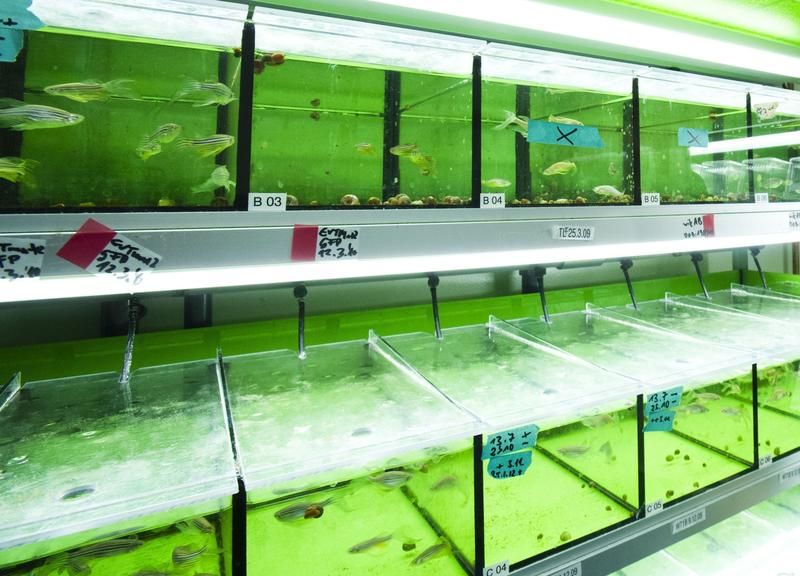
"Zebrafish are robust, small, and reproduce quickly. Being vertebrates, they share most major organ systems with humans. This makes them ideally suited for biomedical research," explains Professor Uwe Strähle, Head of the Institute of Toxicology and Genetics (ITG) that operates the Zebrafish Resource Center on KIT's Campus North. "Zebrafish repair a spinal cord lesion, heart or kidney diseases or a damaged optic nerve all on their own. Their organ function is restored completely."

Moreover, their eggs are transparent and develop outside of the body of the mother. This allows researchers to observe the development of organs or even individual cells in the embryo as well as in the larva, which is also transparent, without harming adult animals. Such experiments may replace numerous animal experiments with rats or mice. The fish are ideally suited to studying the causes of cancer, heart disease, and behavioral disorders and to evaluating potential drugs. In recent years, laboratories in Europe alone have generated thousands of zebrafish lines, each of which carries either a particular mutation that can serve as a model for human disease, or a fluorescent marker that labels a particular tissue. However, European researchers have been lacking a central repository to store and distribute these fish. The European Zebrafish Resource Center will meet this need in the future. The EZRC has over 3,000 aquaria for keeping live fish as well as freezers capable of holding about 80,000 sperm samples. The EZRC will also be the first zebrafish screening center worldwide, welcoming guest researchers who will perform systematic research on its collection. The scientists will be provided with technologies such as high-throughput synthesis of drug candidates, genome sequencing, and robotics and software developed in-house for sample handling, microscopy, and image analysis. The EZRC will also be the central hub of ZF-HEALTH, a recently started collaborative project funded by the European Commission's 7th Framework Programme.
Watchlist

This is where you can add this news to your personal favourites

Facts, background information, dossiers
More about KIT
Contact
Karlsruher Institut für Technologie (KIT)
Kaiserstraße 12
76131 Karlsruhe
Germany
Phone
+49721608-0
Fax
+49721608-4290
  • News

    More accurate modelling of electron transfer in DNA

    Scientists using computational techniques to look at processes in DNA have employed a surface-hopping approach to predict the degree of charge localisation across nucleobases. The technique should allow more accurate modeling of the effects of charge transfer within the molecule. Different ... more

    Protein folding via charge zippers

    Membrane proteins are the “molecular machines” in biological cell envelopes. They control diverse processes, such as the transport of molecules across the lipid membrane, signal transduction, and photosynthesis. Their shape, i.e. folding of the molecules, plays a decisive role in the format ... more

    Zebrafish -- the stars of biomedicine

    Zebrafish share most organ systems with humans. This makes them ideal model organisms to study the causes of human diseases like cancer or heart diseases. For this purpose, research needs a variety of zebrafish lines. With the European Zebrafish Resource Center (EZRC), Karlsruhe Institute o ... more

  • Research Institutes

    Karlsruher Institut für Technologie (KIT)

    Karlsruhe Institute of Technology (KIT) is a public corporation and state institution of Baden-Württemberg. It fulfills the mission of a university and the mission of a national research center of the Helmholtz Association. KIT focuses on a knowledge triangle that links the tasks of researc ... more

More about Helmholtz-Gemeinschaft
Contact
Helmholtz-Gemeinschaft Deutscher Forschungszentren e.V.
Ahrstrasse 45
53175 Bonn
Germany
Phone
+4922830818-0
Fax
+4922830818-30
  • News

    Protein shaped like a spider

    The protein C4BP is similar to a spider in its spatial form with eight “arms”. The structure of the “spider body” has recently been described in detail by researchers from the Helmholtz Centre for Infection Research (HZI) in Braunschweig and the Technische Universität Darmstadt. This leads ... more

    American biochemist to receive this year's Inhoffen Medal

    How do bacteria cope when exposed to toxic mercury, how are they able to outlast antibiotics, and how can they be killed using so-called "suicide inhibitors?" These are but a few of the many research topics US biochemist Christopher Walsh has devoted his career as a scientist to. Walsh will ... more

    Jülich researchers contribute to "Human Brain Project"

    To understand the human brain using simulation – that’s the vision of the Human Brain Project (HBP). In order to make it a reality, researchers from 23 countries are working together to build a unique infrastructure that will allow them to establish and further develop a brain research and ... more

  • Research Institutes

    Helmholtz-Gemeinschaft Deutscher Forschungszentren e.V.

    The Helmholtz Association contributes to solving major challenges facing society, science and industry with top scientific achievements in six research areas: Energy, Earth and Environment, Health, Key Technologies, Structure of Matter, Transport and Space. With 30,000 employees in 16 resea ... more


Your browser is not current. Microsoft Internet Explorer 6.0 does not support some functions on Chemie.DE