HybrInt Project: Using AI to Combat Drought Stress
Advertisement


d
Instanz: Teilen
Teilen:
14.09.2026 07:47
HybrInt Project: Using AI to Combat Drought Stress
Cornelia Achenbach Stabsstelle Kommunikation und Marketing Universität Osnabrück
How can we conserve water while also producing healthy plants for our food supply? A joint research project between Osnabrück University and the DFKI is using AI and a smart robot to achieve this.
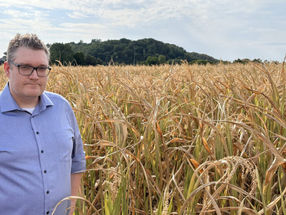
During this scorching summer, not only were temperature records broken in many parts of Germany, but watering bans were also imposed due to water shortages. As a result, many gardens and green spaces now resemble a steppe landscape, and farmers are complaining about crop failures. How can we conserve water while still producing healthy plants for food? A research project at Osnabrück University is addressing this question: Using AI-supported monitoring, the scientists aim to determine how plants exhibit measurable signs of drought stress and how smart water management can be achieved.
“We watch plants die”, says Piper Powell, summing up her research with a laugh. Actually, the 28-year-old has little to do with botany: she’s a computer scientist and part of the HybrInt team. HybrInt is a joint project between the Osnabrück University and the University of Hannover, funded by the Lower Saxony Ministry of Science and Culture with approximately three million Euro. In addition, HybrInt is supported through a collaboration with the German Research Center for Artificial Intelligence (DFKI) in Osnabrück, including assistance from a master gardener, for example, in caring for the plants.
The goal of the project is to develop AI methods that combine the strengths of human intelligence—such as creativity and intuition—with machine intelligence, such as the processing of large amounts of data. Smart water management is a subproject of HybrInt.
In a plastic tunnel at the Arenshorst estate in the municipality of Bohmte, ADA is making its rounds. ADA stands for “Agricultural Data Acquisition Robot” and was developed in 2025 by a team from the university and the DFKI. Equipped with RGB, hyperspectral, depth, and thermal imaging cameras, the tabletop robot can capture thousands of images per hour. This process can automatically generate terabytes of data per experiment.
Currently, ADA is collecting data on plants during their growth and the subsequent drought stress phase. “We let the plants dry out under controlled conditions and record them as they do so,” explains Prof. Dr. Martin Atzmüller, a professor at the Institute of Computer Science at Osnabrück University and head of the Cooperative and Autonomous Systems research division at DFKI. The data is used to train new models that can reliably detect a plant’s current state. “The goal is to deploy resources specifically where and when they are needed most”, says Atzmüller.
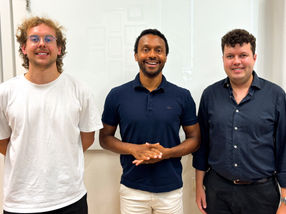
“We’ve even had a zombie moment or two along the way”, says Piper Powell. The doctoral student and her colleagues Amos Smith and Isaak Ihorst once watered some sugar beet seedlings that had completely dried out. And lo and behold: True to the saying “Those declared dead live longer”, the plants actually recovered. “So it’s not that easy to tell when a plant is really dead—at least not with sugar beets”, says Powell.
The data collection is supplemented by so-called “ground-truth” data on drought stress. This includes, among other things, measurements of water content in the leaves by determining leaf thickness and relative water content. In addition, records on plant health and pest infestation are documented. The collected data is then made available via OsnaData, Osnabrück University’s research database. “By making the data openly accessible, we are creating a valuable foundation for further scientific work”, says Prof. Dr. Joachim Hertzberg of Osnabrück University. In this way, the project paves the way for intelligent water management in the future.
Further information for the media: Prof. Dr. Martin Atzmüller, Osnabrück University
Institute of Computer Science
Semantic Information Systems Research Group
martin.atzmueller@uni-osnabrueck.de
Bilder
Merkmale dieser Pressemitteilung: Journalisten Biologie, Ernährung / Gesundheit / Pflege, Informationstechnik, Umwelt / Ökologie überregional Forschungsprojekte Englisch
Ähnliche Pressemitteilungen im idw
15.04.2026 06:40
Drought Takes a Heavy Toll on Bumblebees
Julius-Maximilians-Universität Würzburg
1
14.04.2026 12:10
Cities in the climate storm: How AI is ending flying blind
Deutsches Forschungszentrum für Künstliche Intelligenz GmbH, DFKI
1
27.10.2025 11:07
AGRITECHNICA: Fraunhofer Presents Innovations for the Agriculture of Tomorrow
Fraunhofer-Gesellschaft
1
25.11.2025 07:00
Welcome to the Digital Ecosystem! How a data space makes aerospace more efficient
U Bremen Research Alliance e.V.
1
07.07.2026 08:20
Why Europe’s trees are dying
Eidgenössische Forschungsanstalt für Wald, Schnee und Landschaft WSL
1



Other news from the department science