Two technology start-ups at TH Mannheim receive millions in funding from the federal government
Energy-efficient technology for long-life food and improved radiation protection in the operating theater
Advertisement


As part of the "EXIST Research Transfer" program, two start-ups from Mannheim University of Applied Sciences will receive funding from the Federal Ministry for Economic Affairs and Energy in the amount of one million euros each over the next two years. The two funded start-ups are LiberaZell and Sapientec.
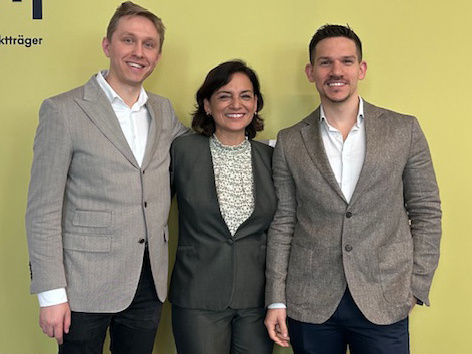
Start-up LiberaZell with Dr. Daniel Cardenas (r.), Dr. Ana Lucia Vasquez-Caicedo and Dr. Tmimothej Patocka
TH Mannheim
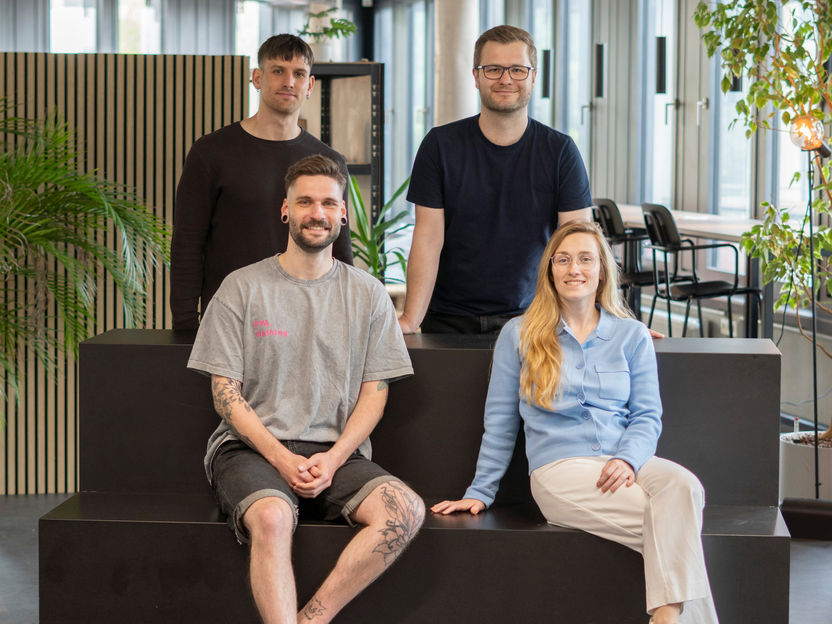
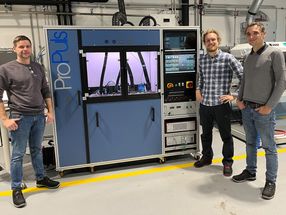
Team Sapientec with Simon Thimm, Niklas Rettig, Patrick Schülein and Mareike Matz-Kellner (from left to right)
TH Mannheim, Michael Ganninger
LiberaZell: energy-efficient technology for long-life food with more nutrients
Conventional pasteurization processes do preserve food, but often lead to the loss of sensitive nutrients due to high temperatures or energy-intensive processes and result in high energy consumption. The start-up LiberaZell is developing a process that allows drinks and other liquid foods to be preserved for longer - and in a much more energy-efficient and gentle way than previous methods.
The team is using pressure change technology (PCT) to achieve this. Unlike traditional pasteurization, the products are not heated to high temperatures. Instead, the process works with moderate pressure at low temperatures. This allows microorganisms and enzymes to be reliably inactivated without losing valuable ingredients. More than 95 percent of sensitive substances such as vitamin C or carotenoids are thus preserved. The technology is suitable for juices, plant-based drinks and other high-quality liquid products and can be integrated into existing production facilities. It also opens up applications in biotechnology, for example for extracting valuable ingredients from microorganisms.
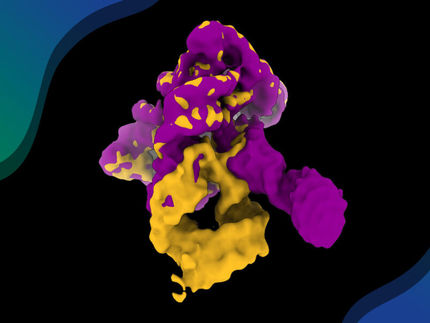
The process was developed over many years at the Fraunhofer Institute for Interfacial Engineering and Biotechnology IGB under the leadership of Dr. Ana Lucia Vasquez-Caicedo. Her team at the TH Mannheim also includes Dr. Daniel Cardenas, Dr. Tmimothej Patocka and Deborah Herdt. As part of the EXIST research transfer, the founding team now wants to optimize the technology and prepare it for industrial use.
Sapientec: improved radiation protection in the operating theater
The start-up Sapientec is also one of the recipients of the EXIST research transfer. The project focuses on the AI-supported assistance system AI.Dos, which aims to improve radiation protection for medical staff during image-guided interventions.
Healthcare professionals are exposed to ionizing radiation every day in the operating theatre. The solution developed by Sapientec visualizes scattered radiation in the intervention room, calculates organ-specific radiation exposure in real time and supports automated documentation. The aim is to improve occupational safety in everyday clinical practice and at the same time reduce the administrative workload. The combination of sensor technology, real-time tracking and AI-supported radiation modeling makes radiation exposure data-based and situation-specific traceable for the first time. The funding program enables the further development of the technology through to clinical application. In particular, the focus is on technical completion, proof of clinical benefit and initial pilot installations in clinics. Close cooperation with clinical partners will enable feedback from the field to be obtained at an early stage and solutions to be developed iteratively.
The technology is being developed at the Institute for Applied Artificial Intelligence & Robotics (A²IR) at Mannheim University of Applied Sciences under the direction of Prof. Dr. Marcus Vetter in close collaboration with Heidelberg University and clinical partners, in particular Prof. Dr. Schönberg and Prof. Dr. Diehl. The foundations of the technology were developed as part of an interdisciplinary cooperation project at the M²OLIE research campus, in which the aforementioned institutions and other partners were involved.
In February 2026, the team of Patrick Schülein, Simon Thimm, Niklas Rettig and Mareike Matz-Kellner was also successful in the nationwide ASAP (Academic Seed Accelerator Program) funding program of the NXTGN innovation platform. Since March 2026, the company has also been part of the Life Science Accelerator Baden-Württemberg and the start-up network NEXT Mannheim.
"The approval of two EXIST research transfer projects is a special confirmation for our university of the successful cooperation of many offices for the promotion of start-ups," says Prof. Dr. Oliver Hummel, Head of the MARS start-up center at TH Mannheim. "Our aim is to provide start-up teams with the best possible support on their path to self-employment. That's why we not only provide infrastructure and workspaces, but also accompany the founders with individual advice and targeted pitch training via the MARS Start-up Center."
Prof. Dr. Julian Reichwald, Vice-Rector for Digital Transformation, Sustainability and Cooperation, adds: "This success is impressive proof that we are able to successfully transform innovative ideas from application-oriented research into viable business models and support founders at a high level. At the same time, we are sharpening our profile as a research and transfer-oriented university and increasing our visibility in the national competition."
About the EXIST Transfer of Research funding program
The EXIST Transfer of Research funding program is one of the most renowned and selective funding programs for research-based high-tech spin-offs in Germany. Only outstanding technology-oriented start-up projects with a high degree of innovation, scientific excellence and clear market potential are funded. The funding is aimed in particular at projects with challenging and high-risk development work on the way to market maturity. The program is funded by the German Federal Ministry for Economic Affairs and Energy (BMWE) and the European Union via the European Social Fund Plus (ESF Plus).
Both projects underwent a demanding, multi-stage selection process. From a total of 63 applications submitted nationwide, the projects were first selected as part of an internal assessment and then invited to present to a jury of experts from the Federal Ministry for Economic Affairs and Energy. The jury was made up of high-ranking representatives from the fields of science, medical technology, venture capital and innovation funding.
Note: This article has been translated using a computer system without human intervention. LUMITOS offers these automatic translations to present a wider range of current news. Since this article has been translated with automatic translation, it is possible that it contains errors in vocabulary, syntax or grammar. The original article in German can be found here.



Other news from the department business & finance










Most read news










More news from our other portals











Something is happening in the life science industry ...
This is what true pioneering spirit looks like: Plenty of innovative start-ups are bringing fresh ideas, lifeblood and entrepreneurial spirit to change tomorrow's world for the better. Immerse yourself in the world of these young companies and take the opportunity to get in touch with the founders.