Key player in cell metabolism identified
Advertisement


Researchers from the Genomic Instability and Cancer Laboratory at Institute for Research in biomedicine (IRB Barcelona) have identified a key role for EXD2 in protein production in the mitochondria, the cellular organelles responsible for the majority of energy generation.
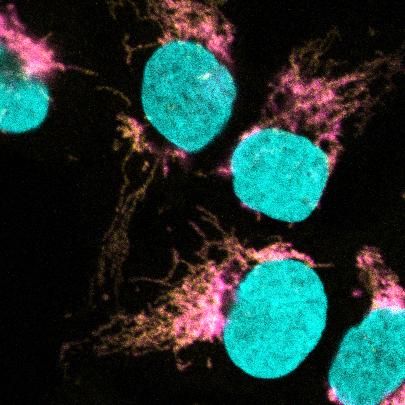
Confocal microscopy shows co-localization of EXD2 (magenta) with the mitochondrial ribosome (yellow). DNA is stained to define the nucleus (cyan).
Travis Stracker, IRB Barcelona.
"We have provided extensive evidence that EXD2 is a mitochondrial protein and that its main function is to facilitate the production of proteins in the mitochondria," explains Travis H. Stracker, head of the laboratory.
This work challenges the interpretation of previous studies that suggested that EXD2 performs a DNA repair function in the nucleus. "However, at this point we can't rule out other possible functions", declares Stracker.

The study presents the results from a collaborative multidisciplinary approach, using state of the art proteomics, metabolomics, biochemistry, cell biology and the development of the fruit fly, Drosophila melanogaster, to pinpoint the function of EXD2.
Cleaning up the energy production process
Scientists identified the mitochondrial ribosome (or mitoribosome), the cellular machine required for protein production in the mitochondria, as a major interactor of EXD2. "EXD2 targets messenger RNA to keep the mitoribosome "clean" until it is mature and ready to generate proteins. In the absence of EXD2, cells are severely defective for mitochondrial protein production," explains Joana Silva, first author of the study and former PhD student of the Genomic Instability and Cancer Laboratory.
EXD2's role in the mitoribosome is critical for suppressing the generation of Reactive Oxygen Species (ROS), that can arise due to mitochondrial defects, and facilitating normal development in Drosophila. Flies lacking EXD2 showed increased ROS levels, delayed development and reduced fertility.
"The results highlight the complexity of mitochondrial protein production and demonstrate that many levels of regulation remain to be elucidated", says Stracker.
Potential target for metabolic disorders and cancer therapy
These studies may have implications for the understanding and treatment of metabolic disorders, such as diabetes, and cancer. In relation to the latter, in recent years, the importance of mitochondrial energy generation in tumors has been revisited and the inhibition of protein production has been proposed to be a therapeutic target by many groups.
As EXD2 is an enzyme and required for mitochondrial translation, it is possible that targeting it could have antitumoral effects, something that will be tested in future experiments.
Original publication


Other news from the department science


















Most read news











More news from our other portals















Last viewed contents

Merck Signs Definitive Agreement to Acquire Life Science Company Mirus Bio for US$ 600 million - "This strategic acquisition is a further building block for accelerating growth in the break-through technologies of the future"
Mayo Clinic researchers map prostate cancer relapse - By using C-11 choline PET and MRI
LDC and Roche will jointly advance innovative drug discovery projects - LDC Enters new Industry Partnership for the Discovery of Novel Medicines
Two colour technique reveals how X-ray lasers damage biomolecules - Step to a fuller understanding of how X-ray flashes modify the structure of proteins

QIAGEN acquires Genoox - "As part of QIAGEN, we can together drive the next wave of precision medicine"
D-Cycloserine Reduces Cocaine-Seeking Behavior in "Addicted" Mice - Antibiotic that appears to control phobias may also be useful in treating addiction
Thermo Fisher Scientific Forms Consortium to Drive Immunotherapy Research Across Europe
Aeras awarded €11.7 million ($16 million) grant from Dutch government
Thermal microscopy of single cells