Films and coatings made from chitin-containing residues
Biorefinery for the processing of chitin and production of high-quality chitosan
Advertisement


The processing of crustaceans from fisheries, the production of insect protein or mushroom cultivation generates large quantities of chitin-containing residues. The Fraunhofer Institute for Interfacial Engineering and Biotechnology IGB has established a process chain for the treatment of chitin in order to utilize these waste streams in a value-adding way. The technologies enable the production of high-purity chitosan, which can be used for sustainable coatings, among other things. Transparent films made from chitosan are suitable as biodegradable disposable packaging and could replace plastics made from crude oil.
The biopolymer chitin is formed as a structural material primarily by crustaceans, insects and fungi and is the second most common biopolymer on earth after plant cellulose. Due to its nitrogen content, chitin is already used as a fertilizer and soil conditioner in agriculture or for the production of chitosan. So far, however, only chitin extracted from crab shells has been used commercially. However, the food industry and biotechnology are increasingly producing hundreds of thousands of tons of chitin-containing residues worldwide: Insect skins from insect protein production, mycelial residues from fermentation with fungi or pruning waste from mushroom cultivation.
Researchers at the Fraunhofer Institute for Interfacial Engineering and Biotechnology IGB have now succeeded in tapping into insect exoskeletons and mycelium-containing residues from fungal fermentation as a source of chitin for the production of chitosan. To this end, the institute has established a process chain for the preparation of chitin, in which residual and waste streams are processed according to the principle of a biorefinery and converted into valuable materials.
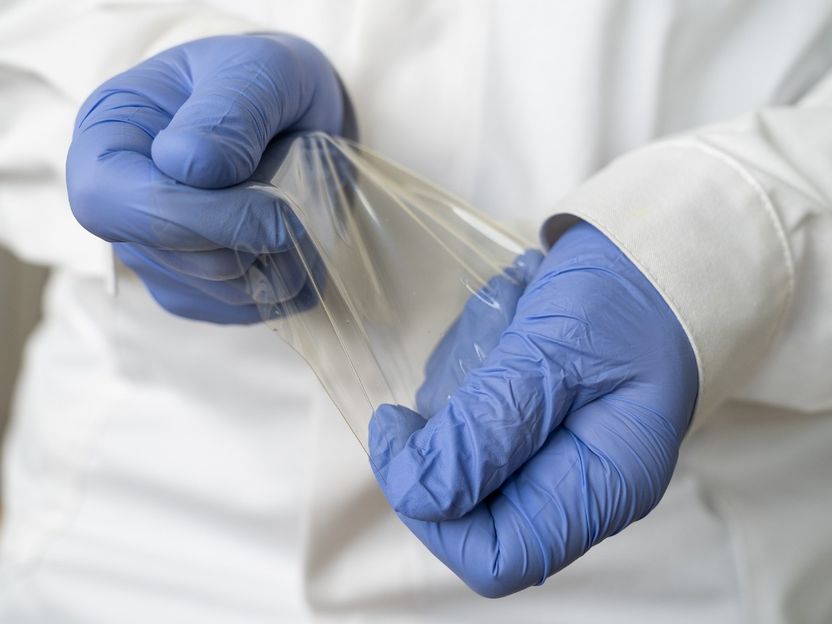
Chitosan films are well suited for packaging applications due to their balanced elasticity and transparency.
© Fraunhofer IGB
Gentle extraction of chitin from various sources
The composition of chitin-containing residues differs from organism to organism. Crab shell and insect chitin, for example, must be freed from calcium deposits and proteins, while chitin in fungal mycelium is often bound to glucans. "We have adapted our processes for extracting chitin to the various residues and adapted the necessary separation and processing steps to the respective chemical composition," explains Dr. Thomas Hahn, who has been investigating the processing of chitin at the Fraunhofer IGB for many years. This also included developing or refining analytical methods to assess the success of the processing. This is because only knowledge of the exact chemical composition of the chitin-containing biomass allows the valuable raw material to be processed in a coordinated manner. The researcher uses newly established analytical methods to check the chitin content of the intermediate products after each individual purification step.
Sustainable and economical at the same time
In order to preserve the chemical-physical properties of chitin, it should be separated from the remaining biomass as gently as possible. Hahn therefore prefers to use aqueous media or enzymes to selectively remove impurities. To ensure that the subsequent industrial implementation is also economical, the chemist evaluates and optimizes the individual process steps on a laboratory scale with regard to scaling up. "If, for example, solvents, reagents or wash water can be reduced or recirculated, this has a positive effect on the costs of the overall process," says Hahn.
Optimized conversion of chitin to chitosan
The water-soluble and therefore versatile chitosan is produced by deacetylation of chitin. However, the production of chitosan from chitin is not trivial and requires chemical finesse and experience. The process usually takes place at high temperatures and under chemically drastic conditions. "In the course of our many years of research, we have been able to mitigate the reaction conditions, further optimize them and increase the yield," says Hahn. With appropriate purification steps, the chemist achieves chitosan with more than 90 percent purity - from crab shells as well as from fungal mycelium and insect skins.
The subsequent analysis of the molecular weight, degree of deacetylation and purification of the respective chitosan product already provides initial indications of possible applications. In the specially developed solvent casting plate test, in which film formation and swelling capacity are tested, Hahn also detects any incompatibilities with cross-linkers.
Chitosan: versatile biopolymer as a replacement for petroleum-based polymers
Chitosan is extremely versatile: it has an antibacterial and anti-odour effect, has adhesion and viscosity-regulating properties, can form films - and is completely biodegradable. Due to its antimicrobial and haemostatic properties and excellent biocompatibility, chitosan is used in wound dressings; the cosmetics industry is already taking advantage of its ability to retain moisture - in the form of moisturizing and skin-caring components in creams and lotions.
As the biopolymer provides binding sites for other functionalities or molecules, Hahn has also modified it in various ways in collaboration with the institute. For example, it can be used as a matrix for a fluorine-free hydrophobic finish for textiles or as a bio-based flocculant for treating complex wastewater.
The ability to form films predestines the biopolymer for coatings and films to replace petroleum-based polymers. Hahn has produced transparent films after adding bio-based crosslinkers. "Thanks to their balanced elasticity and transparency, chitosan films are ideal as sustainable, bio-based and biodegradable disposable packaging, e.g. in the food industry," explains Hahn. Another advantage is that the industrial use of locally available resources can replace fossil raw materials and reduce dependencies on international supply chains.
CHITIN [C8H13NO5] shelter: Textile design prototypes made from spun fibers
Inspired by the natural origin and properties of the material, the SurrealLabor design team explored chitosan as a raw material for textile applications. In the "CHITIN [C8H13NO5] shelter" project funded by the Fraunhofer "Science, Art and Design" network and with scientific support from Thomas Hahn, they spun chitosan threads on a laboratory system built specifically for this purpose using extrusion and wet spinning processes and processed them into a textile fabric as a design prototype. With the production, further development and optimization of chitosan spinning production, the team aims to develop a new, bio-based resource for the textile industry and contribute to a vision of the circular economy of tomorrow.
Note: This article has been translated using a computer system without human intervention. LUMITOS offers these automatic translations to present a wider range of current news. Since this article has been translated with automatic translation, it is possible that it contains errors in vocabulary, syntax or grammar. The original article in German can be found here.


Other news from the department research and development