Merck Delivers Solid Q3 2026 Results and Advances Strategic Priorities Across the Business
Strong contributions by Process Solutions, Rare Diseases and Semiconductor Solutions
Advertisement


Merck posted solid growth in the third quarter of 2026. Performance was driven by Process Solutions, Rare Diseases and Semiconductor Solutions, in line with the company’s focus on high growth value drivers. Group net sales increased to € 5.6 billion year-on-year (Q3 2025: € 5.3 billion), up 5.1% organically. EBITDA pre amounted to € 1.7 billion (Q3 2025: € 1.7 billion). The organic growth of 0.4% reflects a high basis of comparison in the year-earlier quarter, which benefited from several one-time effects. Merck has raised its financial guidance for the full year 2026 and now expects net sales to be between € 21.5 billion and € 21.9 billion and EBITDA pre to be between € 6.2 billion and € 6.4 billion.
“Our third-quarter performance underscores the strength of our integrated business model with our strong position in attractive growth markets, especially biomanufacturing, discovery and development across the life sciences value chain, semiconductor manufacturing that supports AI and advanced nodes, as well as targeted specialty and rare diseases,” said Kai Beckmann, Chairman of the Executive Board and Group CEO of Merck . “We delivered growth in the quarter while continuing to advance our mid- to long- term strategic agenda through innovation and sharpening our portfolio. Our upgraded full-year guidance reflects our confidence that Merck will continue to deliver solid performance in 2026.”
Third-quarter results
Merck increased its Group net sales to € 5.6 billion (Q3 2025: € 5.3 billion). Organic growth of 5.1% was further supported by positive foreign exchange effects of 1.5%. At € 1.7 billion, EBITDA pre was around stable at +0.4% (Q3 2025: € 1.7 billion). As reported at the time, two one-time effects each had added a mid-double-digit million euro amount in the year- earlier quarter. The EBITDA pre margin was 29.9% (Q3 2025: 31.4%). Earnings per share pre amounted to € 2.32, reaching the same level as in the year-earlier quarter (Q3 2025: € 2.32).

Free cash flow increased by 22.7% year-on-year to € 1.3 billion in the third quarter (Q3 2025: € 1.1 billion). The strong cash generation supports Merck's deleveraging: By the end of the quarter, net financial debt had declined by 10.3% since the beginning of the year.
All three business sectors increased net sales across regions and portfolios. Customer projects, capacity expansions and higher demand were the main drivers. With a share of 34.8% of net sales, Asia-Pacific grew by 12.1% and was once again the company’s largest market. Europe remained the second- largest market with a share of 29.1%, followed by North America at 24.5%.
Sharpened portfolio advances company strategy
In June 2026, Merck entered into a definitive agreement to acquire Bio- Techne Corporation, USA, for an enterprise value of approximately US$ 11.3 billion (€ 9.9 billion). Bio-Techne is a global provider of life science tools, analytical technologies and consumables. The acquisition significantly expands the Merck portfolio and strengthens the company’s ability to support customers from biological discovery to therapeutic development and manufacturing.
Merck also signed a definitive agreement to divest its contract development and manufacturing organization (CDMO) business within Life Science to Lonza. The transaction advances Merck’s mid- to long-term strategic agenda and is expected to close in mid-2027. It positions the CDMO business for its next phase of development under an organization with a dedicated focus on contract development and manufacturing.
In October 2026, Merck announced a definitive agreement to acquire Silence Therapeutics , United Kingdom. Once completed, the transaction will add divesiran to the Merck pipeline: The potentially best-in-class, phase III- ready siRNA investigational therapy is in development for phlebotomy-dependent polycythemia vera, a type of rare blood cancer. Divesiran is dosed subcutaneously once every three months. The planned acquisition is a strategically important step toward strengthening the company’s mid-stage pipeline and its focus on targeted specialty and rare diseases, one of Merck’s high growth value drivers. The transaction is expected to close in the first quarter of 2027.
Guidance for 2026
Based on the Group’s performance in the third quarter, Merck has raised its full year 2026 guidance. The company now expects net sales to be between € 21.5 billion and € 21.9 billion and EBITDA pre to be between € 6.2 billion and € 6.4 billion. This adjustment primarily reflects improvements in the underlying performance and more favorable foreign exchange effects. In addition, the guidance reflects the acquisition of Bio-Techne for the month of December 2026 as a portfolio effect in the Life Science business sector. This is an assumption; the actual closing date of the transaction may differ. The guidance further assumes no sales of Mavenclad ® in the United States from November 2026 (previous guidance: from August 2026) amid generic competition.
As a result, the implied organic growth corridor for Group net sales shifts to +3% to +4%. Organic EBITDA pre growth is now expected at +3% to +5%. Merck anticipates foreign exchange effects to impact net sales between –1% to 0%; for EBITDA pre, the range is –2% to 0%. This translates to an EPS pre between € 8.30 and € 8.70.
Life Science sustains growth momentum and sharpens portfolio focus
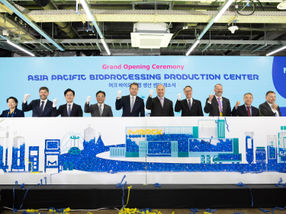
Life Science sustained strong underlying performance and positive momentum in the third quarter, supported by growth across its businesses and regions. Continued commercial execution under the go-to-market model and customer demand across key markets, especially Asia-Pacific, drove its performance. Net sales of Life Science reached € 2.4 billion, representing organic growth of 6.1% compared to the year-earlier quarter. Excluding the impact of tariff refunds to customers, organic growth was 7.3%. EBITDA pre was € 736 million, a strong organic increase of 8.7% year-on-year. The business sector increased R&D expenses and startup costs associated with new manufacturing sites, for example in Daejeon, Korea, to support future growth and advance its region- for-region strategy.
Process Solutions remained the main growth driver. The business unit, which offers solutions for every step of pharmaceutical manufacturing, delivered organic sales growth of 10.5% in line with the communicated normalizing growth rate in the second half of 2026. Demand was strong across downstream processing, single-use solutions, and upstream and processing materials. While underlying demand and customer capacity expansion remain strong, order book trends point to a softer fourth quarter.
Discovery Solutions, which supports research and early-stage discovery across biology, chemistry and analytical workflows, grew by 1.7% organically. Performance was supported by demand across the portfolio, with positive momentum in Asia-Pacific.
Advanced Solutions achieved organic sales growth of 4.3%. The business unit delivers tailored products and services that help customers address unique needs in high-touch and regulated environments. Both products and services contributed with growth across key regions.
In line with the innovation-led strategy of Merck, Life Science advanced a broad range of research and development initiatives. Recent launches include the continued advancement of MAST ® , a system that automatically collects samples during biopharmaceutical manufacturing: The first autosampler fully validated for use in commercial production under Good Manufacturing Practice standards. Its analytical integrations provide automated access to critical process and quality data, supporting faster, evidence-based process decisions. AI and digitalization also remained important areas of focus. Merck introduced new features for mConfig™, including real-time trace element prediction that helps customers identify potential variability in cell culture media formulations before manufacturing. Merck also launched SYNTHIA ® Agentic AI, giving scientists natural-language access to retrosynthesis, reagent and safety information within compatible AI environments.
The proposed divestment of the CDMO business would further sharpen Life Science’s portfolio focus, allowing it to concentrate investments on technologies and capabilities that build on its scientific leadership. Life Science's broad range of consumables, technologies and services will continue to support pharmaceutical, biotechnology and CDMO customers from discovery through manufacturing.
Healthcare continues to deliver strong performance in Rare Diseases
In Healthcare, Rare Diseases, Fertility & Endocrinology and Cardiometabolic contributed to growth amid tailwinds from foreign exchange effects. In the third quarter of 2026, net sales reached € 2.3 billion, an organic increase of 0.9% year-on-year. EBITDA pre remained stable at € 819 million. The organic decline of 3.6% was offset by positive foreign exchange effects of 3.8%.
Rare Diseases, a high growth value driver for Merck and a new strategic pillar in Healthcare, grew 41.5% organically. With organic growth of 80.4%, Gomekli ® /Ezmekly ® was the main growth driver. The treatment is approved for adults and children aged 2 years and older with neurofibromatosis type 1 who have plexiform neurofibromas. Sales of Ogsiveo ® , indicated for the treatment of progressing desmoid tumors, increased by 24.5% organically. Pimjetmi ® (pimicotinib), approved in China in December 2025 for the treatment of tenosynovial giant cell tumor (TGCT) also added to sales in the quarter.
Net sales in Cardiometabolic grew by 5.2% organically. This was mainly driven by double-digit growth of Concor ® , while Euthyrox ® and Glucophage ® also contributed positively.
Net sales in Fertility & Endocrinology increased by 3.6% organically. Pergoveris ® , indicated for the stimulation of follicular development in women with severe luteinizing hormone and follicle-stimulating hormone deficiency, grew organically by 14.1%. Sales of Gonal-f ® , a follicle- stimulating hormone treatment, were organically down by 2.4%. Saizen ® , for the treatment of various growth hormone disorders, recorded organic sales growth of 16.4%.
Specialty Care saw net sales decline by 10.2% organically. Erbitux ® , a treatment for metastatic colorectal cancer and for cancer of the head and neck, grew organically by 4.3%. This growth was supported by strong demand in Europe, in turn related to a recent label extension by the European Commission covering additional patient segments in colorectal cancer. Net sales of Mavenclad ® on the other hand declined by 25.1% organically, mainly reflecting generic competition in the United States.
In October, Merck announced new two-year follow-up data from the Phase III MANEUVER study, evaluating pimicotinib in patients with tenosynovial giant cell tumor (TGCT). The data, which was presented at the European Society for Medical Oncology (ESMO) Congress 2026, showed durable tumor control and sustained improvements in TGCT symptoms and joint function with pimicotinib.
On November 10, the FDA approved Pimjetmi ® (pimicotinib) , a once-daily oral colony stimulating factor-1 receptor (CSF-1R) inhibitor, as a systemic treatment for adults with symptomatic tenosynovial giant cell tumor (TGCT) for which surgical resection may cause worsening functional limitation or severe morbidity.
Electronics: Continued strong growth supported by AI-driven demand
The Electronics business sector delivered continued strong growth in the third quarter of 2026. This development was supported by the ongoing momentum in the semiconductor industry and was driven in particular by demand from data centers and AI-related applications. Net sales increased organically by 13.3% to € 948 million. The reported increase of 8.4% included a portfolio effect of –5.7% from the divestment of the Surface Solutions business unit. EBITDA pre increased by 18.4% to € 279 million, driven especially by higher volumes, favorable product mix and efficient cost management.
All businesses in Semiconductor Solutions contributed to a strong organic growth of 18.7% in the third quarter, proving the strength of a broad and enabling portfolio for advanced memory and logic applications. The results reflect the sustained growth of the semiconductor industry in 2026 and were driven by demand for advanced nodes for logic and memory chips used in AI applications. These applications require increasingly complex chip architectures with higher material content per wafer and tighter process control. Consequently, demand for the high-performance specialty materials and workflow solutions offered by Merck continues to be robust.
Organic sales in Optronics declined by 0.9%. High prices for memory chips continued to weigh on end customer demand for consumer electronics, resulting in persistent price pressure and lower demand for liquid crystals. However, positive foreign exchange effects more than offset this development.
Merck continues to invest in local markets and collaborate with key players in the industry. The company recently opened a new research and development facility for materials development, scale-up and technology transfer in Sheboygan, Wisconsin, USA, as part of a US$ 200 million multi-year investment. The facility brings materials innovation closer to customers and supports the company’s focus on AI-driven wafer processing. In Eumseong, Korea, Merck opened a new production line for molybdenum-based materials. The site combines Thin Films and Delivery Systems & Services capabilities and is expected to begin commercial production following customer qualifications in 2027.


Other news from the department business & finance