Fruit Flies in Defense Mode: How Immune Cells Encase Parasites While They're Still Alive
Marburg Researchers Discover a Key Switch in the Innate Immune Response Against Parasitic Wasps
Advertisement


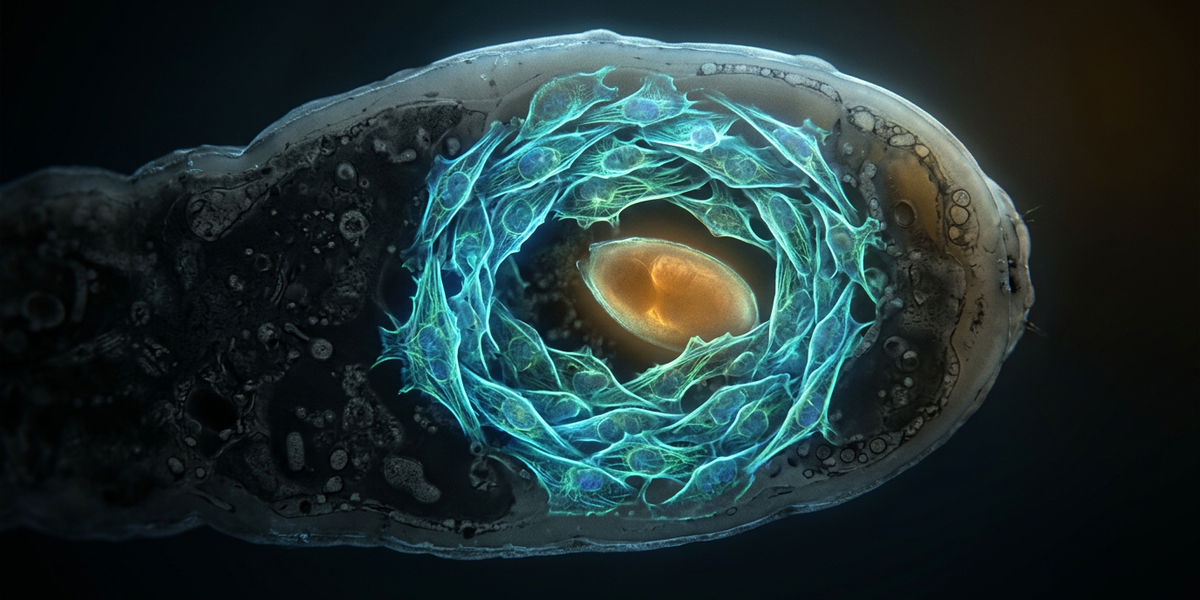
A tiny parasitic wasp lays its eggs inside a fruit fly larva. If the wasp larva hatches unimpeded, it devours its host from the inside. But the fruit fly has an astonishingly effective defense strategy: Giant, specialized immune cells, known as lamellocytes, attach themselves to the wasp egg, change their shape, and encase the intruder in a multilayered capsule until it dies. A research team led by Prof. Dr. Sven Bogdan at Philipps University of Marburg has now identified, for the first time, the molecular switch that enables this spectacular cellular transformation. At the center of this process is the highly conserved actin regulator Frl/FMNL, which is activated by the molecules Cdc42 and Rac2 and reorganizes the cytoskeleton of the immune cells for encapsulation.
Wasp larva eats its way through the interior of the fly larva
Using high-resolution live-cell microscopy and atomic force microscopy, the researchers were able to observe for the first time in real time how the lamellocytes change. In their resting state, they circulate passively and rigidly in the larva’s body fluid—similar to platelets in human blood. Only upon contact with a wasp egg are they activated: The actin cytoskeleton undergoes a profound restructuring, the cells become softer, spread across the surface of the parasite’s egg, and form a protective capsule. If Frl/FMNL or one of its activators—Cdc42 or Rac2—is missing, this remodeling fails. The immune cells can no longer enclose the wasp egg—the parasites continue to develop and ultimately kill the fruit fly larva.
Too Big to Eat: Immune System Devises Alternative Strategy
These findings extend far beyond the fruit fly. Frl/FMNL belongs to a family of actin regulators that are also found in humans and control the shape and motility of immune cells. Eosinophils, in particular, use a similar strategy when defending against large parasites such as worms: Because these invaders are too large to simply “eat,” they are encapsulated by immune cells. The new findings therefore provide important insights into fundamental mechanisms of the innate immune system and could help to better understand innate immune deficiencies caused by disruptions in the actin cytoskeleton and, in the long term, lead to the development of new therapeutic approaches.
Note: This article has been translated using a computer system without human intervention. LUMITOS offers these automatic translations to present a wider range of current news. Since this article has been translated with automatic translation, it is possible that it contains errors in vocabulary, syntax or grammar. The original article in German can be found here.
Original publication


Other news from the department science











Most read news










More news from our other portals















See the theme worlds for related content
Topic World Cell Analysis
Cell analyse advanced method allows us to explore and understand cells in their many facets. From single cell analysis to flow cytometry and imaging technology, cell analysis provides us with valuable insights into the structure, function and interaction of cells. Whether in medicine, biological research or pharmacology, cell analysis is revolutionizing our understanding of disease, development and treatment options.
Topic World Cell Analysis
Cell analyse advanced method allows us to explore and understand cells in their many facets. From single cell analysis to flow cytometry and imaging technology, cell analysis provides us with valuable insights into the structure, function and interaction of cells. Whether in medicine, biological research or pharmacology, cell analysis is revolutionizing our understanding of disease, development and treatment options.