Dynamic gates guard the cell nucleus
Advertisement


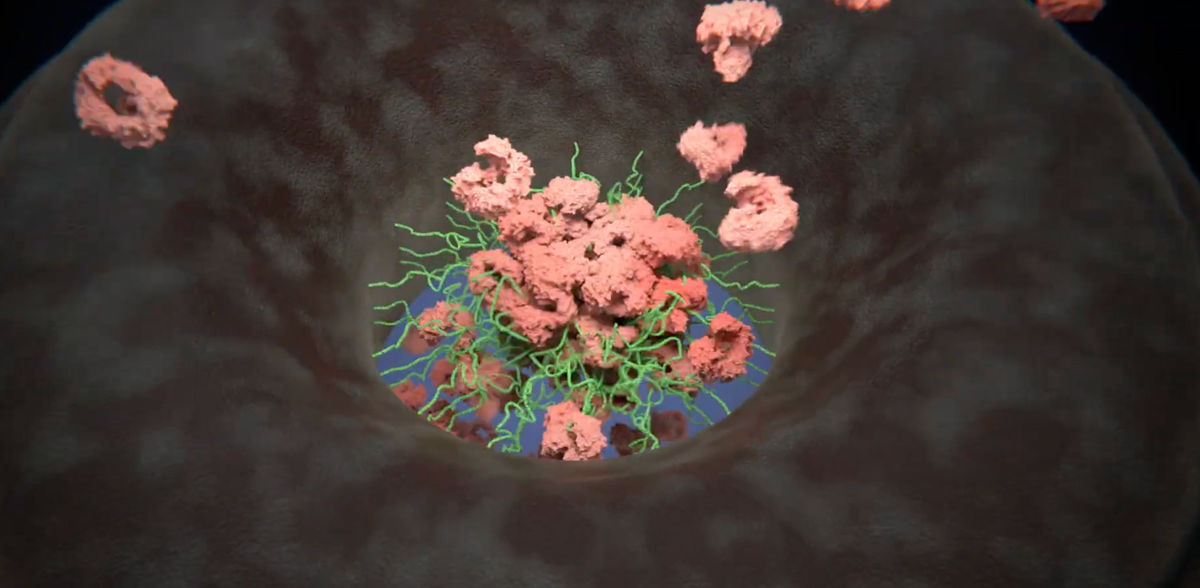
An international study led by the University of Basel shows that nuclear pore complexes - tiny passages in the cell nucleus membrane - are not rigid or gel-like, as previously assumed. Their interior is dynamically organized, constantly moving and changing. These results change our understanding of an important transport process in cells and have implications for diseases and possible therapies.
The cell nucleus is like a bank vault, protected by nuclear pore complexes (NPCs) like a sophisticated security system. Only proteins with the right "key" - special transport factors - are granted exclusive access. In this way, the system controls which substances enter or leave the cell nucleus. This tight control is essential to ensure smooth communication between the genome protected on the inside and the cellular machines on the outside.
New biological insights thanks to nanoscience
Despite their importance, the inner workings of nuclear pore complexes are still a mystery. Their transport channel is lined with highly flexible protein filaments - FG nucleoporins (FG Nups). They form a selective barrier whose ultra-fine structure remains hidden even to the most powerful electron microscopes. Since the FG Nups can form gel-like structures outside the cells, older models have compared the function of the nuclear pore complexes with a rigid sieve.
Now, a team led by Prof. Dr. Roderick Lim, Argovia Professor of Nanobiology at the Biozentrum and Swiss Nanoscience Institute at the University of Basel, has used high-speed atomic force microscopy (HS-AFM) to film never-before-seen nanometer-scale movements with millisecond resolution directly inside the pores. The researchers have now published the discovery of the extraordinary restructuring within the nuclear pore complexes in the journal "Nature Cell Biology".
"The nuclear pore complex barrier is loosely organized by a mobile central plug, the components of which have long been enigmatic. It turns out that it consists of a dynamic mixture of transport factors, cargo molecules and FG-Nups that mix along the central axis of the pore. This creates a highly adaptable system that reinforces the barrier while ensuring rapid selective transport," Lim explains.
Swimming with the current
The team discovered this dynamic organization while studying nuclear pore complexes from yeast cells. The resulting high-speed AFM movies also showed the fluid movements of the FG nups "radiating" to the central plug inside the pore.
"When we observed isolated nuclear pore complexes for extended periods of time under controlled conditions, the central plug of the nuclear pore complexes disappeared. When we added nuclear transport factors again, it formed again," reports Dr. Toshiya Kozai, first author of the study. Remarkably, transport factors also restored a barrier function similar to the nuclear pore complexes in artificial nanopores - an indication of the general validity of this mechanism.
Hydrogels resemble sponges with holes
Nuclear pore complexes are often compared to hydrogels. "This is because FG nups form hydrogels in vitro - i.e. in the test tube - but they are thousands of times larger than the nuclear pore complexes. However, they consist of tangled fiber-like structures that are simply too large to fit into a nuclear pore complex, let alone the entire hydrogel body itself," explains Lim.
"When we examined the hydrogels more closely, we found that they were littered with holes of irregular shape and size - like a kitchen sponge. Many of these holes were the size of nuclear pore complexes or even larger. They could possibly mimic a behavior similar to that of nuclear pore complexes."
Challenges for the future
The self-organized, dynamic behavior revealed in the study provides a unified view of nuclear pore complexes that is consistent with long-standing structural and biochemical observations - with implications ranging from basic cell biology to the design of smart filters and drug delivery systems.
Restricting the dynamic state of the pores impairs selective transport into the nucleus, highlighting how important this behavior is for proper cell function.
"The next challenge is to understand how cells fine-tune these remarkable nanomachines in response to changing needs - how the pores adapt to stress, regulate growth and, when clogged, contribute to disease," adds Prof. Dr. Michael Rout of Rockefeller University, who co-led the work.
Note: This article has been translated using a computer system without human intervention. LUMITOS offers these automatic translations to present a wider range of current news. Since this article has been translated with automatic translation, it is possible that it contains errors in vocabulary, syntax or grammar. The original article in German can be found here.
Original publication
Toshiya Kozai, Javier Fernandez-Martinez, Larisa E. Kapinos, Paola Gallardo, Trevor van Eeuwen, Martin Saladin, Roi Eliasian, Adam Mazur, Wenzhu Zhang, Jeremy Tempkin, Radhakrishnan Panatala, Maria Delgado-Izquierdo, Raul Escribano-Marin, Qingzhou Feng, Chenxiang Lin, Andrej Sali, Brian T. Chait, Barak Raveh, Liesbeth M. Veenhoff, Michael P. Rout, Roderick Y. H. Lim; "Karyopherins remodel the dynamic organization of the nuclear pore complex transport barrier"; Nature Cell Biology, 2025-12-2


Other news from the department science