HI viruses crack the lock to the cell nucleus
For the first time, researchers have observed how HIV penetrates the nuclear pores to the genome of human immune cells
Advertisement


Researchers at the Max Planck Institute of Biophysics and the University of Heidelberg have discovered how Hi viruses enter the nucleus of a human cell. The conical protein capsules in which the genetic material of the pathogens is packed accumulate at nuclear pores in human immune cells such as macrophages and pass through them. The conical shape of the capsid seems to facilitate transport through the pores, because the passage of the capsules generates a force that breaks open the rings of the nuclear pores. The discovery could contribute to the development of new HIV inhibitors.
Human immunodeficiency virus type 1 (HIV-1) targets important cells of our immune system, making infected individuals more vulnerable to diseases and infections. Once inside human cells, HIV integrates the viral genome into that of the human host. Ultimately, the virus uses our body’s machinery to produce copies of itself and spread infection.
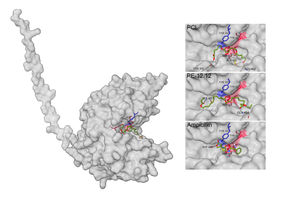
The HIV-1 capsid is formed by a mesh of around 200 protein hexamers and pentamers, arranged similarly to a football. It is however not spherical, but shaped like a cone, with a narrow and a wider end. This capsule contains the viral payload. And for successful infection, it has to ultimately open up and release the viral genetic information into the host cell. In their work, the groups of Martin Beck and Gerhard Hummer from the Max Planck Institute of Biophysics in Frankfurt and Hans-Georg Kräusslich from the Heidelberg University Hospital combined high-resolution imaging with sophisticated computational simulations to study nuclear entry of HIV-1 capsids in infected human immune cells called macrophages.
Guardians of the genome
Nuclear pore complexes are the guardians of the human genome that is packaged into the nucleus of all cells. They form selective channels through the envelope of the nucleus and connect its interior to the cytoplasm. Those channels are filled with specialized proteins called FG-nucleoporins, who act as bouncers at the entrance door. They control which molecules can enter the channel and which ones need to stay outside of the nucleus. The invader needs to pass this barrier to deliver its payload into the nucleus.
HIV capsid achieves this by mimicking the properties of human proteins. It is therefore attracted to the channel instead of being excluded. However, the authors highlight that at its widest dimension, the capsid has a similar size as the pore channel diameter. This fact supported an initial hypothesis that capsids dissolve and release the viral genetic material before reaching the nucleus. However, the new evidence pushes to reconsider how the HIV-1 genome enters the nucleus.
Broken rings
Using state-of-the-art cellular tomography and super-resolved microscopy, the authors were able to observe HIV capsids inside of infected cells. They found that capsids had entered the nuclear pore channel with their narrow ends first, and pushed further and further to approach the nucleus. Other than expected, the capsids did not show any signs of deformation or breakage inside of the nuclear pore channel. Instead, the researchers detected a significant number of nuclear pores that were cracked open once the broad end of the cone had pushed deeply inside the channel and approached the nucleus.
The authors suggest that the entry of the capsid into the nuclear pore complex generates a force that stretches the pore in its width until its ring-shaped structure cracks, similar to a nail that breaks its surrounding structure once driven forward. This crack widens the channel and allows the capsid’s progression into the nucleus. Computational simulations of the process support this hypothesis: the capsid could only pass through the pore when the ring diameter was increased or if the ring cracked. These findings provide a potential explanation for the evolution of the unique HIV capsid structure: its conical shape might be necessary to break the nuclear pore complex and to complete the import of the viral genome.
HIV treatments
Over the past decades understanding and treating HIV infection has advanced tremendously. This year the drug lenacapavir, which blocks release of the viral genome in the cell and effectively prevented HIV infection in clinical trials, was granted Food and Drug Administration (FDA) PrEP Breakthrough Therapy Designation and was also named Breakthrough of the Year by the journal Science. Lenacapavir prevents spread and infection in individuals that have access to the drug. It however cannot undo the integration of the virus’ genetic information into the human genome and thus is no ‘cure’. Still, not all aspects of HIV infection are fully understood. Uncovering further details of its mechanism will aid the ultimate goal of eradicating the virus.
According to first author Jan Philipp Kreysing, this study marks an important moment in HIV research as elucidates the molecular details of a critical step during infection. Jan Philipp remarks that the already approved capsid-targeting drug lenacapavir is one great example for the relevance of such basic research for people’s lives. Interestingly, lenacapavir stabilizes HIV capsid even further, most likely preventing its opening up entirely. If cracking the nuclear pore provides the virus with a critical advantage, such as the delivery of a larger payload, remains an open question. Also, how the capsid ultimately opens up inside of the nucleus to release the viral genome has to be further investigated. Thus, understanding how HIV interacts with infected human cells will remain an active area of research.
Original publication


Other news from the department science