Research suggests SARS-CoV-2 could survive for a month on refrigerated or frozen meat products
Advertisement


SARS-CoV-2 surrogates can survive on meat products in the refrigerator or the freezer, for up to 30 days. Those findings are published in Applied and Environmental Microbiology, a journal of the American Society for Microbiology.
The research was conducted using chicken, beef, pork and salmon, and surrogate viruses with spikes similar to those on SARS-CoV-2, as surrogates, said first author Emily S. Bailey, Ph.D. The investigators stored the products at both refrigeration (4oC, or 39.2oF) and freezer temperatures (-20oC, or -4oF).
“Although you might not store meat in the fridge for 30 days, you might store it in the freezer for that long,” said Bailey. “We even found that the viruses could be cultured after [being frozen for] that length of time.” Bailey is assistant professor, Department of Public Health, College of Pharmacy and Health Sciences, Campbell University, Buies Creek, N.C.
The investigators undertook this research after learning that COVID-19 outbreaks were occurring in Southeast Asia absent prior community transmission. Reports from those communities “suggested that packaged meat products, produced in areas where SARS-CoV-2 was circulating, could have been the source of the virus,” said Bailey. “Our goal was to investigate whether or not similar viruses could survive in this environment.”
The research is important because SARS-CoV-2 can replicate within the gut, as well as in the respiratory tract, said Bailey.
In the study, the investigators used 1 RNA virus with a lipid envelop, and 2 animal coronaviruses, murine hepatitis virus, and transmissible gastroenteritis virus as surrogates.
All 3 viruses have previously been used as surrogates for SARS-CoV-2, generally with greater reductions in their numbers observed at refrigeration than at freezing temperatures. The reduction in numbers also varied according to the food item used.
“Continued efforts are needed to prevent contamination of foods and food processing surfaces, worker hands and food processing utensils such as knives,” the investigators wrote. Additionally, “the lack of, or inadequate disinfection of these foods prior to packaging needs to be addressed.”
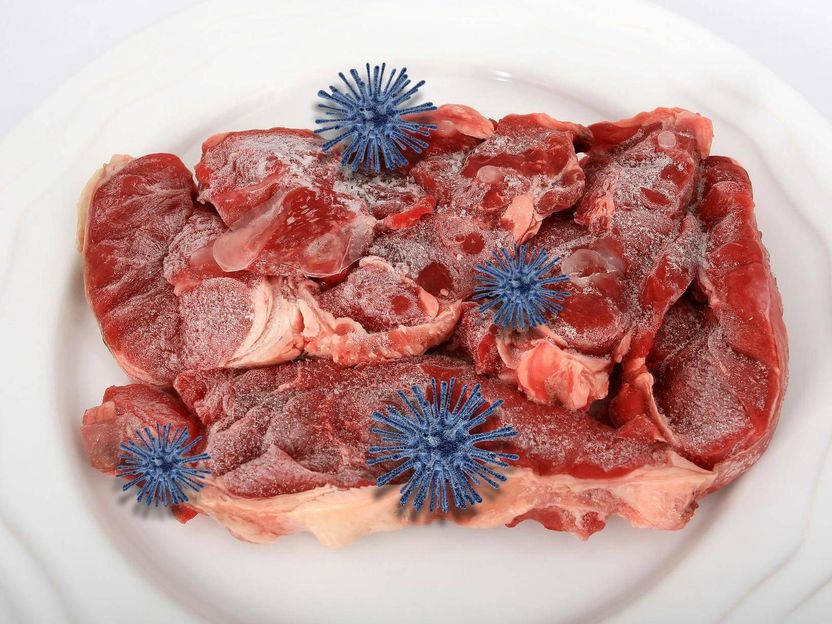
Symbolic image
Unsplash/pixabay.com
Original publication



Other news from the department science


















Most read news











More news from our other portals
















Last viewed contents
Heptares enters a research and drug discovery collaboration with Juntendo University
Novasep and instrAction enter a worldwide strategic alliance for non-chiral chromatography
Kedrion and ProMetic Form Strategic Alliance to Develop Orphan Drugs from Plasma
Alnylam and PBL Sign Licence Agreement for Baulcombe & Hamilton RNAi patent
QIAGEN and ActiveSight Sign Co-Marketing Agreement Targeting Protein Crystallography
U.S. Development Partner Quest Diagnostics Completes Clinical Development of Septin9 Colorectal Cancer Blood Test
Global Pharmaceutical companies expect hard price competition in the rising Biosimilars segment - Bi-annual survey among more than 80 executives from globally active pharmaceutical companies based in 16 countries and spread over four continents
Metobolomics uncovers key indicators of nonalcoholic fatty liver disease - Impaired oxidation in liver associated with progression to NASH
Converting carbon dioxide into useful chemicals with the help of bacteria and solar power - How electrolysis and fermentation can be combined in one system
Agilent Technologies Presents Thought Leader Award to Lipidomics Expert Dr. Jules Griffin - Cambridge Researcher to Further Studies of Obesity, Fatty Liver Disease