Hidden genetic variations power evolutionary leaps
Advertisement


Laboratory populations that quietly amass ‘cryptic’ genetic variants are capable of surprising evolutionary leaps, according to a paper in the July 26 issue of Science. A better understanding of cryptic variation may improve directed evolution techniques for developing new biomolecules for medical and other applications.
Genetic variation – that is, accumulated mutations in the DNA – is the fuel for all evolutionary change: the more genetic variation, the faster evolution works and the more possibilities for novel adaptive solutions.
But one kind of genetic variation – hidden, or “cryptic,” variation – doesn’t alter the appearance or behavior of an organism in its usual environment.
“It’s an underappreciated kind of genetic variation,” says corresponding author Andreas Wagner, an evolutionary biologist at the University of Zurich and external professor at the Santa Fe Institute, “and it plays an important role in evolution.”
Previous work has shown that cryptic variation in natural populations promotes rapid evolutionary adaptation. But the underlying molecular mechanisms were unclear.
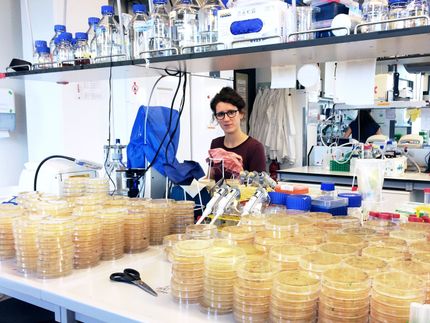
To explore those mechanisms, Wagner’s team worked with populations of the gut bacterium E. coli that carried a plasmid with a gene for a yellow fluorescent protein (YFP). The team designed a two-stage experiment. In stage 1, they used mutagenic PCR to increase variation in the YFP gene. Simultaneously, they selected for a narrow range of yellow fluorescence. Any bacteria not sufficiently yellow were excluded, a process called ‘stabilizing selection.’ In this way, they built up deep stores of cryptic genetic variation without altering the yellow color of the YFP protein.
During stage 2, the team changed the selection rules and began selecting for E. coli that fluoresced in the green part of the spectrum (‘directional selection’). They also introduced control populations of E. coli that lacked enhanced cryptic variation in YFP. The E. coli cell lines with stores of cryptic variation evolved green fluorescent protein (from YFP genes) that were both greener and genetically more diverse than any produced by the control E. coli lineages.
In the experiment, says co-author Joshua Payne (ETH Zurich), cryptic variation did more than drive evolutionary adaptation faster. Cell lines with deep reserves of cryptic variation evolved greener YFP proteins, forms of the protein that were inaccessible to regular bacteria, and they evolved by multiple unique routes not available to regular E. coli.
Current laboratory directed evolution often leads to the same evolutionary outcomes each time. The new work shows how amassing cryptic variation can open doors to otherwise inaccessible regions of protein sequence space, says first author Jia Zheng, a post doctoral researcher at the University of Zurich.
In the wild, cryptic variation helps fish adapt to life in caves. In the lab, cryptic variation might help a biomolecule bind a new receptor. “Our work can help develop new directed evolution strategies to find innovative biomolecules for biotechnological and medical applications,” says Zheng.
Like a fat savings account, cryptic variation is a store of variation that becomes available in an emergency to fuel rapid evolutionary change critical to the survival of a lineage and useful for molecular biologists.
Original publication


Other news from the department science


















Most read news











More news from our other portals















Last viewed contents

Merck Signs Definitive Agreement to Acquire Life Science Company Mirus Bio for US$ 600 million - "This strategic acquisition is a further building block for accelerating growth in the break-through technologies of the future"
Mayo Clinic researchers map prostate cancer relapse - By using C-11 choline PET and MRI
LDC and Roche will jointly advance innovative drug discovery projects - LDC Enters new Industry Partnership for the Discovery of Novel Medicines
Two colour technique reveals how X-ray lasers damage biomolecules - Step to a fuller understanding of how X-ray flashes modify the structure of proteins

QIAGEN acquires Genoox - "As part of QIAGEN, we can together drive the next wave of precision medicine"
D-Cycloserine Reduces Cocaine-Seeking Behavior in "Addicted" Mice - Antibiotic that appears to control phobias may also be useful in treating addiction
Thermo Fisher Scientific Forms Consortium to Drive Immunotherapy Research Across Europe
Aeras awarded €11.7 million ($16 million) grant from Dutch government
Thermal microscopy of single cells