Researchers from the “Physics of Life” Cluster of Excellence Discover What Triggers Changes in Cell States
The Tgm2 enzyme initiates histone serotonylation in the cell nucleus before neural crest cells begin to migrate
Advertisement


Collective cell migration is a key process in development in which groups of cells move together as a single unit. This movement shapes embryos, repairs damaged tissue, and drives the spread of cancer through metastasis. It is therefore of central importance to understand the physical and molecular factors underlying this collective behavior. A team from the Cluster of Excellence Physics of Life (PoL) at the Technical University of Dresden (TUD) has now described a mechanism that puts cell populations into a migratory state. The findings were published in the journal *Nature Cell Biology*.
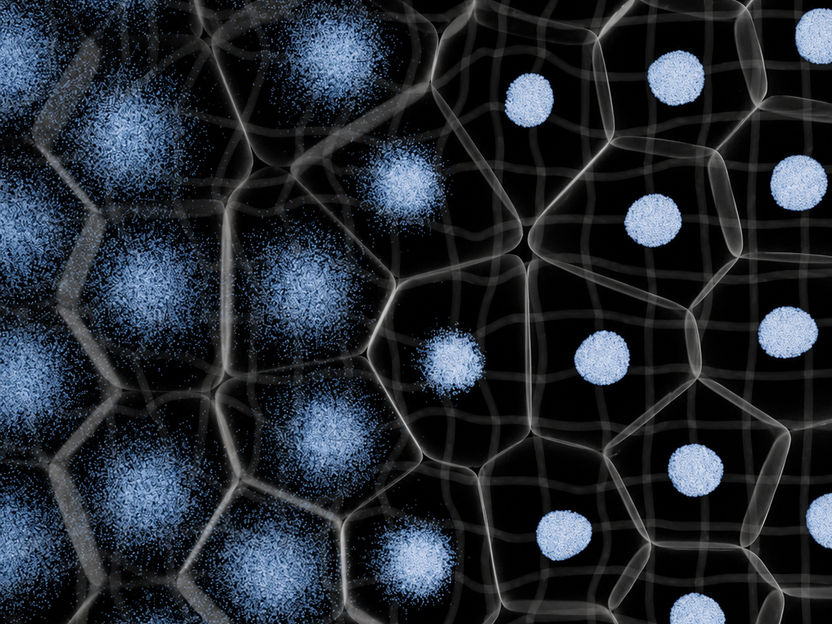
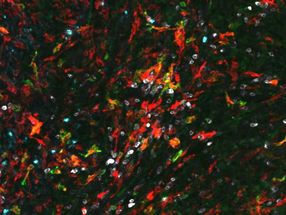
Artist's rendering of the study: a layer of cells surrounded by tissue that becomes stiffer from left to right. The light blue particles represent the enzyme Tgm2.
Copyright: Julien Marcetteau
Long before we take our first breath, cells are already in motion. For embryos to take shape, groups of cells must move together in a coordinated manner. This movement, known as collective cell migration, also aids in wound healing, the formation of body parts, and even their regrowth during regeneration. However, how cells decide when to start moving remains an open question—and researchers are studying early developmental stages to find answers.
How Cells Begin Their Migration
One example of collective cell migration is a population of embryonic stem cells that exists only temporarily: the cranial neural crest. These cells migrate along a predetermined path and form bones and muscles in the face and neck, as well as blood vessels and even parts of our nervous system. This cell population thus offered researchers at the Cluster of Excellence Physics of Life (PoL) the ideal opportunity to investigate how cells begin their migration. “We had previously studied the neural crest and shown that the mechanics of the tissue trigger cell migration. But we didn’t know what changes occur within the cells themselves,” says Dr. Elias Barriga, who led the study.
A New Perspective on Cell Migration
The researchers discovered that a specific histone modification—known as histone serotonylation—must occur for collective cell migration to begin. Dr. Elias Barriga’s team demonstrated that the enzyme Tgm2 enters the cell nucleus and initiates serotonylation as soon as the tissue becomes stiffer.
The study, now published in *Nature Cell Biology*, reveals a chain of events that leads to collective cell migration: The tissue becomes stiffer, the enzyme Tgm2 enters the cell nucleus, proteins (histones) in the cell nucleus are chemically marked, gene activity changes—and finally, the cells begin to move. “In terms of the broader significance of this work, our findings suggest a mechanism through which tissue mechanics can help cells refine their state while preserving their potential to develop into specialized cell types,” says Elias Barriga.
“I was fascinated to see how tissue mechanics can fine-tune chromatin and shape cell states,” says Joana Saraiva, the study’s first author. “These findings have inspired me to investigate whether similar mechanisms are at work in other developmental and disease contexts.”
Genes Do Not Control Development Alone
Since collective cell migration is central to development, wound healing, and the spread of cancer, understanding how cells translate mechanical signals into gene activity could open up new avenues of research in these areas. The newly discovered mechanism also shows that genes do not control development on their own: it is the interplay between the physical properties of tissues and their molecular components that sets cells in motion.
Note: This article has been translated using a computer system without human intervention. LUMITOS offers these automatic translations to present a wider range of current news. Since this article has been translated with automatic translation, it is possible that it contains errors in vocabulary, syntax or grammar. The original article in German can be found here.
Original publication


Other news from the department science