How Dying Cancer Cells Suppress the Immune System
Mechanism Discovered That Could Enable New Cancer Treatments
Advertisement


Inducing the selective death of cancer cells is a key goal of cancer research. Particularly promising in this regard is a process known as ferroptosis: a form of cell death in which certain lipids in the cell membrane are damaged. The targeted induction of ferroptosis could also help in the future with tumors that have responded poorly to existing treatments. Researchers led by Prof. Dr. Jan Böttcher from the Faculty of Medicine and University Hospital Tübingen have now discovered why this form of cell death does not always lead to the complete elimination of a tumor. Dying cancer cells can produce a signaling molecule that inhibits the body’s own immune defense.
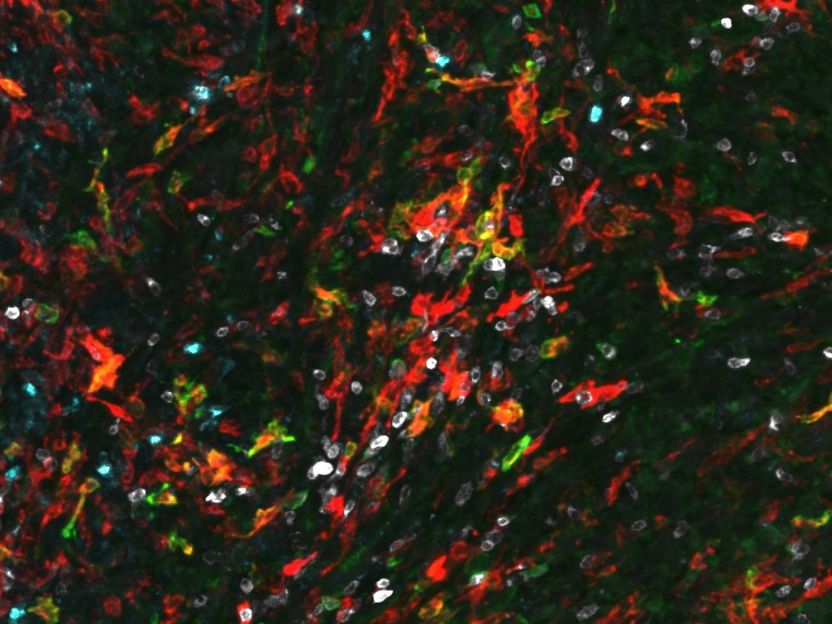
This high-resolution microscopic image of a ferroptotic tumor illustrates how blocking PGE2 signaling enables type 1 conventional dendritic cells (cDC1) to promote antitumor T-cell responses against ferroptotic cancer cells in tumor tissue. cDC1 are shown in red, T cells in gray, and MHC-II-positive immune cells in green.
Jan Böttcher
“Our results show that it is not enough to kill cancer cells through ferroptosis. It is also crucial that the immune system be able to effectively combat the tumor,” explains study leader Prof. Dr. Jan Böttcher. “We have identified a mechanism by which dying cancer cells suppress the immune response. If we can specifically disable this mechanism, the effectiveness of future cancer therapies could improve.”
Targeting the Link Between Cell Death and Immune Defense
The research team led by first author Lukas Ramsauer first examined cancer cells in the laboratory, including human tumor cells and cells from patients with pancreatic cancer. The experiments showed that during ferroptosis, the cell membrane becomes more permeable, allowing calcium to enter the cell. This activates a signaling cascade that leads to increased production of the signaling molecule prostaglandin E2 (PGE2). This molecule impairs certain immune cells that normally activate other immune cells to attack the tumor.
In subsequent experiments, the researchers confirmed the significance of this mechanism. In a mouse model, the researchers succeeded in neutralizing the inhibitory effect of the signaling molecule on certain immune cells. As a result, the immune system was able to completely eliminate the tumors. In further mouse experiments, the combination of a ferroptosis-inducing agent with a drug that inhibits PGE2 production improved the control of tumor growth. Crucially, the inhibitory effect on the immune system could be blocked without preventing the death of cancer cells. The results open up a potential approach for future combination therapies. However, whether this strategy is also effective and safe in humans must first be investigated in clinical trials.
The research was primarily funded by the DFG Priority Program 2306 “Ferroptosis.” It was conducted in close collaboration with research groups from Collaborative Research Center 1479 “OncoEscape,” the iFIT Cluster of Excellence, and the Institute of Molecular Immunology at the Technical University of Munich. The team led by Prof. Dr. Jan Böttcher also received additional support from the European Research Council (ERC) as part of the Consolidator Grant “EICO-CODE.”
Note: This article has been translated using a computer system without human intervention. LUMITOS offers these automatic translations to present a wider range of current news. Since this article has been translated with automatic translation, it is possible that it contains errors in vocabulary, syntax or grammar. The original article in German can be found here.
Original publication


Other news from the department science