Unique Symbiosis Gives Single-Celled Organisms a Sense of Magnetism
LMU researchers have discovered an unusual three-way partnership between a ciliate, bacteria, and archaea.
Advertisement


How do microorganisms navigate to find the optimal habitat? It has already been well documented that so-called magnetotactic bacteria use the Earth’s magnetic field as a biological compass. Some eukaryotic single-celled organisms—that is, more complex organisms such as ciliates, which, unlike bacteria, have a cell nucleus—also possess this ability. However, how they acquired it has remained largely a mystery until now. An international team led by Professor William Orsi from the Department of Earth and Environmental Sciences at LMU has now discovered a previously unknown magnetotactic ciliate that employs an unusual strategy: symbiosis with two partners simultaneously within its cell.
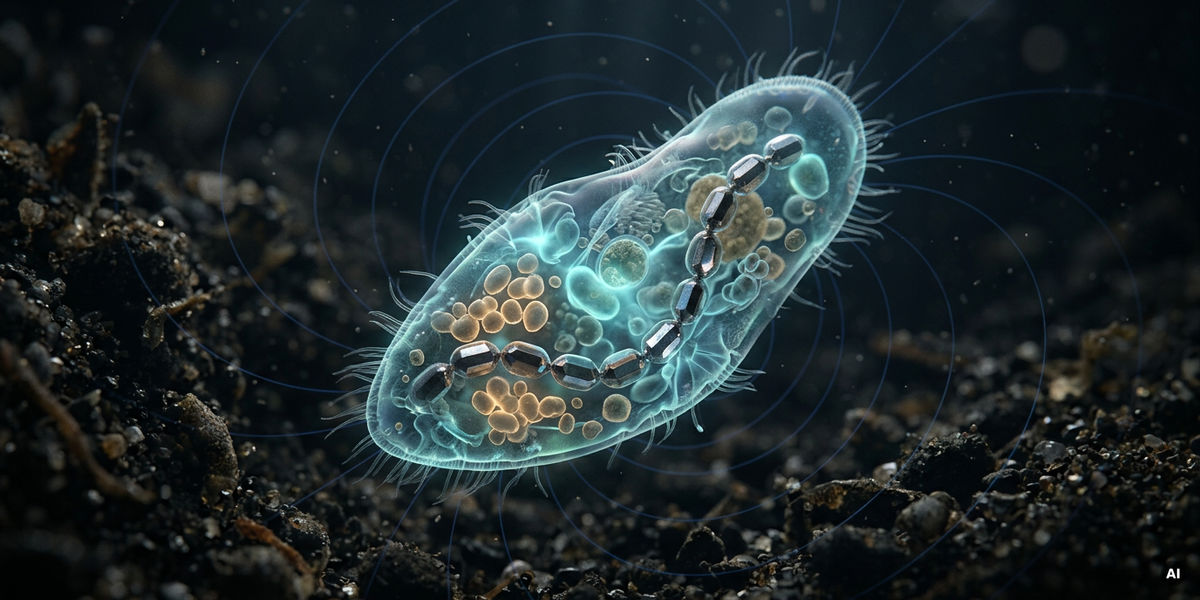
The researchers found the new ciliate, Tropidoatractus magnetotacticus, in oxygen-poor river sediments near Libreville in Gabon. Electron microscope images revealed that it contains tiny magnetite particles arranged in a string-of-pearls-like structure that help it orient itself to the magnetic field—and that these particles originate from living bacterial symbionts inside the single-celled organism. “When we first observed these cells, it immediately became clear to us that we were dealing with something unusual. The discovery that they orient themselves with the help of these endosymbionts revealed a fascinating new way in which eukaryotes can utilize the Earth’s magnetic field,” says Leon Kaub, co-first author of the study with Mitali Chitnis.
Cooperation as an Adaptation to the Habitat
Furthermore, the microscopic images suggested that the ciliate has even more microbial partners. Genetic analyses confirmed this: In addition to the magnetite-forming symbionts, the ciliate also harbors methane-producing archaea, which utilize the ciliate’s metabolic byproducts, thereby creating favorable conditions for the partners’ energy metabolism in the oxygen-free sediments. Together with orientation toward the Earth’s magnetic field—which helps the ciliates swim downward and reach oxygen-poor sediments more quickly—this symbiosis enables all partners to survive more efficiently in their ecological niche.
“Our discovery opens up new perspectives on the evolution of the magnetic sense,” says Chitnis. “According to this, this ability can arise not only through the evolution of a single organism, but also from a long-term symbiosis between different microorganisms.” Orsi adds: “Now that this type of symbiosis has been discovered, I expect that many more similar cooperative relationships will be found in oxygen-free environments and that these relationships are more common than previously thought.”
Note: This article has been translated using a computer system without human intervention. LUMITOS offers these automatic translations to present a wider range of current news. Since this article has been translated with automatic translation, it is possible that it contains errors in vocabulary, syntax or grammar. The original article in German can be found here.
Original publication


Other news from the department science