The power of gut enzymes: why a healthy diet works differently for everyone
Advertisement


Researchers from the Cluster of Excellence "Balance of the Microverse" at the Friedrich Schiller University Jena and the Leibniz-HKI, together with international partners, have decoded a mechanism that determines how our gut microbiome processes healthy plant substances. The "chemical cookbook" of intestinal bacteria is different for every person - and is often disrupted in chronic diseases. The results pave the way for personalized nutrition plans that specifically promote balance in the microbiome.
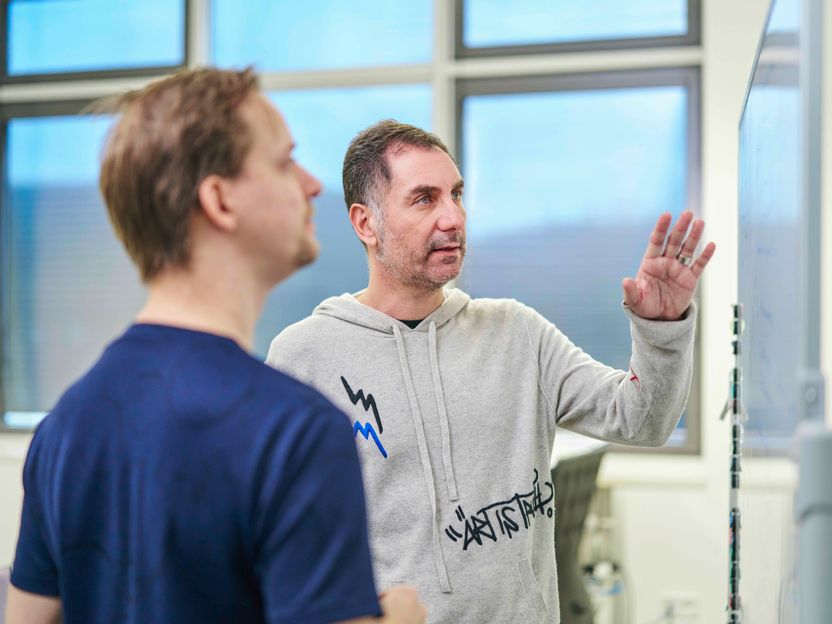
Prof. Dr. Gianni Panagiotou (r.) in conversation with a team colleague.
Anna Schroll
The microbiome: our second, invisible chemical factory
Many healthy plant substances, such as those from berries, nuts or vegetables, are not immediately effective in the form in which we eat them. They first have to be chemically converted by the countless microorganisms in our gut - a kind of "second digestion". The international research group was able to systematically map 775 different phytonutrients and their conversion by the enzymes of the intestinal bacteria. This showed that on average 70 percent of all enzymes in our microbiome are potentially involved in this processing. That is much more than was previously known.
However, the study also revealed a crucial challenge: The "chemical cookbook" of gut bacteria is extremely individual. Whether a particular person can optimally convert a healthy plant substance into its active form depends on which specific enzymes their intestinal flora possesses. This ability differs not only from person to person, but also according to geographical origin and dietary habits.
Prof. Dr. Gianni Panagiotou, Professor of "Microbiome Dynamics" at the Friedrich Schiller University Jena at the Leibniz-HKI, emphasizes the importance of multidisciplinary collaboration: "Our results show how crucial the function of the microbiome is for the effects of a healthy diet. Only through collaboration between bioinformaticians, chemists, disease model specialists and microbiologists were we able to capture the entire diversity and dynamics of gut bacteria."
When the "cookbook" is faulty during illness
The researchers used artificial intelligence to compare the enzyme profiles of healthy and sick people, including patients with inflammatory bowel disease, bowel cancer or non-alcoholic fatty liver disease. The result was clear: in patients with these chronic diseases, the potential of the microbiome to process healthy food was significantly reduced.
The AI models were able to predict with a high degree of accuracy whether a person was healthy or ill based on the quantities of certain bacterial enzymes. For example, patients with bowel cancer were found to lack an important enzyme for processing a healthy plant substance that was present in higher quantities in healthy individuals. This reduced conversion capacity could explain why general dietary recommendations often do not have the expected effect in chronically ill patients.
The path to a customized diet
To decipher these complex relationships, the team used a combination of bioinformatics and the comparison of over 5,500 human gut microbiomes from around the world. Promising bacterial strains were then tested in the laboratory to experimentally confirm the predicted transformation reactions.
These groundbreaking findings form the basis for the nutritional medicine of the future. Instead of universal advice, the analysis of the individual microbiome could soon make it possible to create precise, personalized nutrition plans. The aim is either to provide the microbiome with the right nutrients or to "vaccinate" it with probiotics that contain precisely the enzymes that are missing for the optimal processing of healthy plant substances.
Excellent collaborative research
The study ties in directly with the central research topics of the Cluster of Excellence "Balance of the Microverse" in Jena: the systematic research of microorganisms and their interaction with the host. The research underlines the fact that a balanced microbiome is crucial for our health not only in terms of its composition, but above all in terms of its function - i.e. its ability to chemically process food. The scientists are thus providing an important building block for promoting this balance through targeted, individualized interventions.
Note: This article has been translated using a computer system without human intervention. LUMITOS offers these automatic translations to present a wider range of current news. Since this article has been translated with automatic translation, it is possible that it contains errors in vocabulary, syntax or grammar. The original article in German can be found here.
Original publication
Lu Zhang, Andrea Marfil-Sánchez, Ting-Hao Kuo, Bastian Seelbinder, Loes van Dam, Ana Depetris-Chauvin, Leonie Johanna Jahn, Morten O. A. Sommer, Michael Zimmermann, Yueqiong Ni, Gianni Panagiotou; "Gut microbiome-mediated transformation of dietary phytonutrients is associated with health outcomes"; Nature Microbiology, 2025-12-3


Other news from the department science