 Verified
Schlauchdrucksensor
Contactless tube pressure measurement – this is how it’s done
Convenient - Easy to mount directly on the hose’s outside
Non-invasive - Perfect for sterile applications, no contact with the medium in the hose
Versatile - Suitable for hose and tube diameters from 4.8 to 19.1 mm
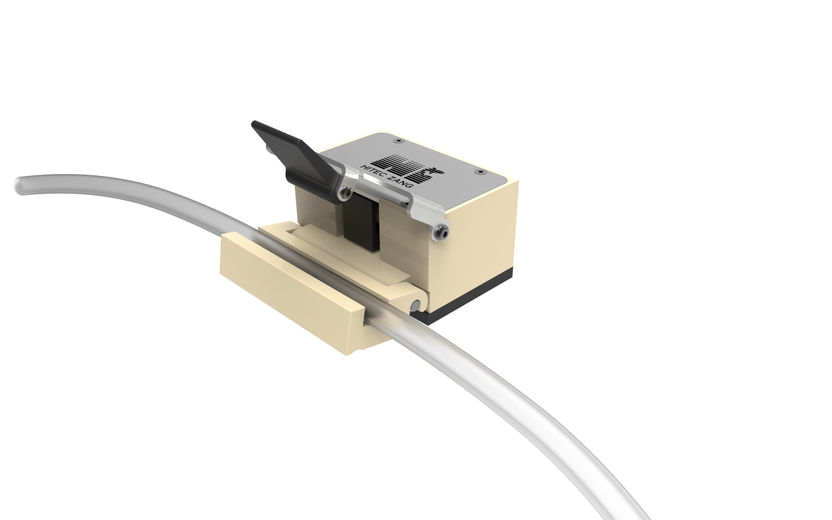
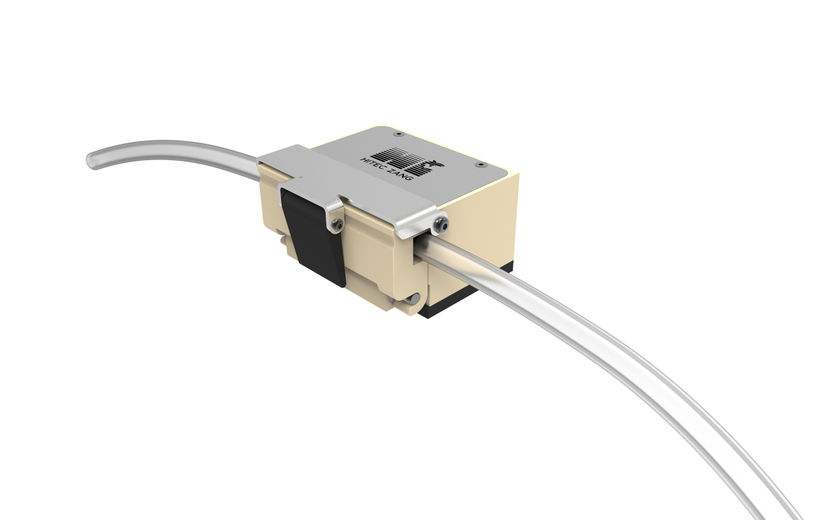
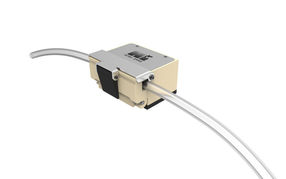
Convenient filter monitoring and clogging detection from the outside while sterility is maintained
Tube Pressure Sensor – Non-Contact Pressure Measurement for Sterile Processes
Measure pressure without touching the medium. The HITEC ZANG tube pressure sensor simply clamps onto the outside of the tubing. No inline components, no media contact, no contamination risk.
The problem: clogged filters and pumps are often detected too late
Pressure measurement is essential in process plants. It is how you detect clogged filters or pumps in time, before they cause system failures or equipment damage. Conventional pressure sensors have to be installed inside the line. In sterile bio and pharma processes, that is a problem: every inline component is a potential source of contamination and makes sterilization more difficult.
The solution: clamp-on measuring principle
The tube pressure sensor measures the wall force of the tubing from the outside. The medium only touches the tubing material, so your process stays closed and sterile. The measuring principle is patent-protected.
Handling is as simple as it gets. Sterilize your system as usual, then insert the tubing, close the sensor, and start measuring. Retrofitting existing systems is possible at any time.
Typical applications
- Filter monitoring in sterile, biotechnological processes
- Early detection of clogging in filters and pumps
- Differential or absolute pressure measurement in tubing
- Process development in lab and pilot plant for biotech, pharma, and chemistry
- Anywhere inline installation is not possible or not desired
Easy integration
Thanks to its analog 4–20 mA interface, the sensor can be integrated into virtually any process control system, such as LabVision, LabManager, LabBox, or third-party systems. Alternatively, you can connect it to an analog display. The sensor itself has no display.
Key technical data
- Tubing diameter: 4.8 mm (3/16″) to 19.1 mm (3/4″), custom sizes on request
- Tubing hardness: Shore A < 70
- Resolution: < 1 mbar
- Reproducibility: ≤ 20 mbar*
- Response time (10…90 %): approx. 1 s*
- Media temperature: 10–50 °C*
- Output signal: 4–20 mA, M12 5-pin connector
- Protection class: IP65
- Materials: PEEK, aluminum, stainless steel
*Measured with 19.1 mm silicone tubing. Because readings depend heavily on the tubing (diameter, wall thickness, material), these values are guidelines. With careful calibration, tubing of 10 mm diameter or larger typically achieves significantly better values.
Your benefits at a glance
- Non-invasive, making it ideal for sterile applications
- Versatile for common tubing used in chemistry, bio, and pharma
- Quick to install, including retrofits
- Differential and absolute pressure with a single sensor
1
Insert hose, close, and you’re done: the easy way to mount this hose pressure sensor saves you time
2
Non-invasive pressure measurement from the outside to maintain sterility
Request information about Schlauchdrucksensor now
Hose pressure sensors: Schlauchdrucksensor
Contactless tube pressure measurement – this is how it’s done

Product classification Schlauchdrucksensor
Product categories
Applications
Manufacturers of similar products


Find Schlauchdrucksensor and related products in the theme worlds
Topic world biopharmaceutical manufacturing
Biopharmaceutical production plays a crucial role in the development and manufacture of biologics, which are essential for the treatment of various serious diseases. Various key technologies and processes of the modern biopharmaceutical industry are used, such as cell cultures, fermentation processes and the purification of biological substances, which are necessary for the production of vaccines, monoclonal antibodies and other biological drugs.

Topic world biopharmaceutical manufacturing
Biopharmaceutical production plays a crucial role in the development and manufacture of biologics, which are essential for the treatment of various serious diseases. Various key technologies and processes of the modern biopharmaceutical industry are used, such as cell cultures, fermentation processes and the purification of biological substances, which are necessary for the production of vaccines, monoclonal antibodies and other biological drugs.