Worldwide success of Tyrolean wastewater treatment technology
Advertisement


The DEMON®-system was developed and patented by the University of Innsbruck 11 years ago. Today this successful technology has been implemented in about 70 wastewater treatments plants around the world. A new partnership has now been formed between the environmental engineers in Innsbruck and the US-utility company DC Water for jointly refining and marketing the technology. In Blue Plains in Washington, DC, USA, the new partner is currently building the world's largest deammonification system in a wastewater treatment plant. Similar systems are currently being planned and built in Stockholm, Singapore, Yokohama and Jerusalem. In northern Europe, the DEMON®-system has been implemented by long-time license holder Sweco, formerly Grontmij, and this partnership is going to be extended with a new contract. Co-developer Bernhard Wett explains the reason why so many major cities have expressed interest in this technology: "The DEMON®-system is particularly interesting for wastewater treatment plants that have reached their capacity-limit because with this technology the treatment of ammonium-rich wastewater can be intensified significantly."
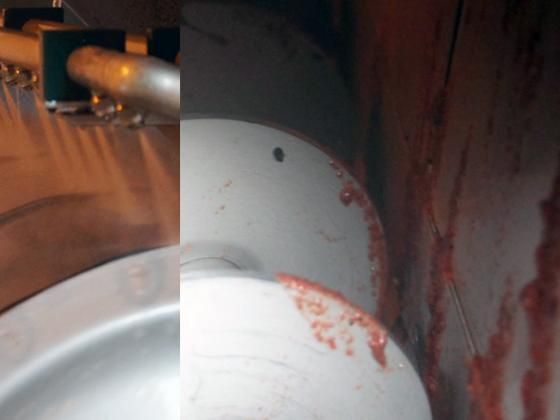
These are photographic details of the drum-screen used for the enrichment of the bright-red granular anammox bacteria in the improved system for CONtinous DEAmmonification (conDEA™) in Strass, Austria.
ARAconsult

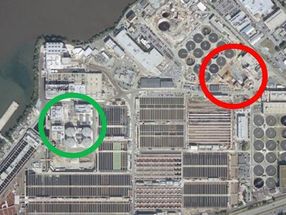
The Blue Plains advanced wastewater treatment plant in Washington DC treats 1.5 million cubic meters of wastewater daily. 10 megawatts of electricity are produced in the newly built sludge digestion plant (green circle). The ammonia return load from this process is eliminated by the DEMON-system currently under construction (red circle).
DC Water
Energy-efficient, environmentally friendly and globally successful
The DEMON®-technology utilizes a biological process for removing large quantities of ammonium from wastewater. "However, it is technically difficult to implement the process because the bacteria grow extremely slowly and are very sensitive," says Bernhard Wett. "We successfully implemented the first system in a wastewater treatment plant in Strass, in the Zillertal valley in Austria. This treatment plant is the first energy self-sufficient wastewater treatment plant globally. Therefore, it can be considered as a prototype of our system, which has attracted interest around the world." This innovative technology uses 60 percent less energy than conventional systems and, moreover, it doesn't require any chemicals. "The development and marketing of the patent has been a huge success story for the University of Innsbruck," underlines Tilmann Märk, Rector of the University of Innsbruck. "With this newly established US-cooperation, it is possible to further refine the technology, which will guarantee its success in the future."


Other news from the department science










Most read news







More news from our other portals










Last viewed contents
MedMira Establishes Joint Venture in China - Deal links MedMira with one of China's leading and oldest pharmaceutical companies