Bioprinting of Highly Complex Structures Now Possible
Cooperation of UpNano and BIO INX yields further advancement: Two-stage 3D-printing of organ-on-chip devices with encapsulated live cells is possible
Advertisement


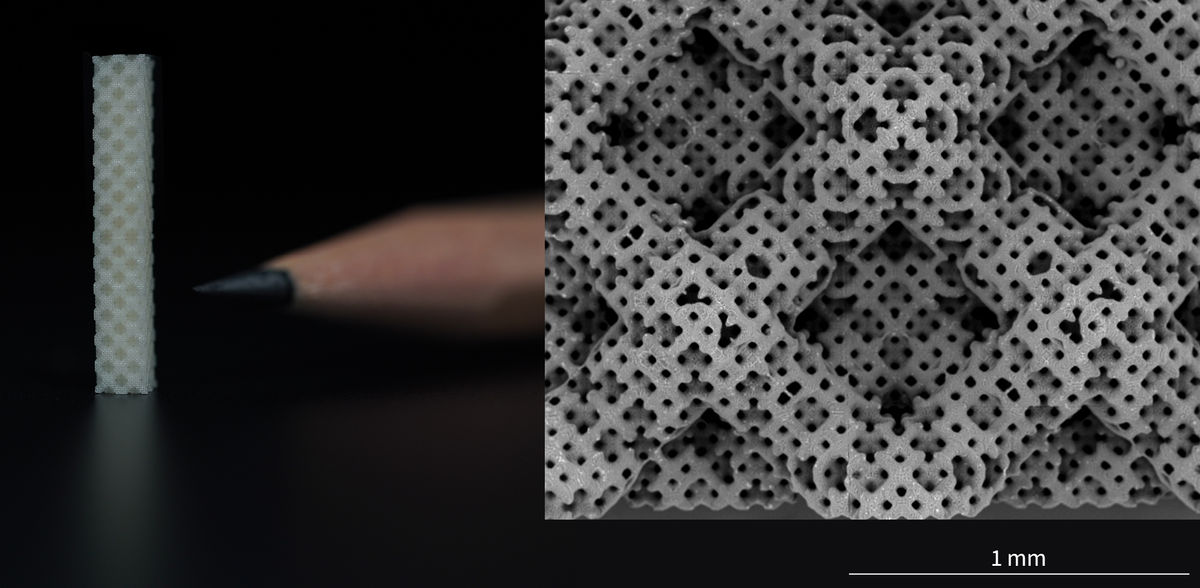
The launch of a new biocompatible hydrogel resin marks the begin of a new era in bioprinting. The novel resin allows 2-photon polymerization (2PP) 3D-printing from micro- to meso-scale at highest resolution. The reactivity and easy processing of the material permits the fabrication of complex and versatile organ- or lab-on-chip designs. This new bioink called Hydrotech INX© U200 has been developed by the material specialist BIO INX (Belgium) in collaboration with UpNano (Austria). The results of this collaboration now allow to add an additional layer of complexity to a bioprinted construct by the smart combination of multiple biocompatible materials. In this respect versatile cancer-on-chip models are possible by combining the newly launched resin with cell-encapsulating gelatin-based hydrogel Hydrobio INX© U200, which is the first commercially available high resolution bio ink that offers cell interactivity.
The ever-increasing possibilities of bioprinting are nurtured by a continuous advancement of 3D-bioprinting technologies. In this, 2-photon polymerization (2PP) 3D-printing excels as it covers the entire spectrum of biological dimensions with one printing technology: sub-micrometer resolution combined with the capability of printing objects at centimeter dimensions (macro-scale). This impressive potential has now been advanced by a set of bioinks jointly developed by BIO INX, 3D-bioprinting material specialist, and UpNano, leading manufacturer of 2PP 3D-printers.
Macrostructures with Micrometer-Precision
With the release of Hydrotech INX© U200 the two companies demonstrate their success in developing a versatile material that enables 2PP 3D-printing of macrostructures with micrometer-precision. The material has been certified according to ISO 10993-5, confirming its excellent biocompatibility. Jasper Van Hoorick, CEO of BIO INX, comments: “In combination with the fact that the material is completely bio-inert, its robust characteristics make Hydrotech INX© U200 the ideal choice for organ-on-chip applications.”
However, in order to benefit from the full potential of the novel bioink, a state-of-the-art high-resolution 3D printer is required. Here, UpNano’s NanoOne 2PP-printer range offers a very suitable choice. The NanoOne is the fastest high-resolution 3D printing system on the market. It is based on multiphoton lithography and combines the precision of 2PP with an unmatched throughput of up to 450 mm³ per hour. On top of that, the NanoOne Bio is specifically adapted for printing with living cells and under sterile conditions – and thus a congenial partner for the most challenging task in bioprinting: fabrication of complex 3D scaffolds for cell cultures whilst embedding living cells into these structures in one simple set-up.
Complex Design – Simple Production
“Combining these steps can easily be done,” explains Denise Hirner, COO and co-founder of UpNano, “by using the NanoOne Bio in combination with the two bioinks Hydrotech INX© U200 for the inert structure and Hydrobio INX© U200 for living cells in 3 dimensions.” In fact, whilst the Hydrotech-bioink is perfectly optimized for the high-resolution fabrication of bioinert but biocompatible microstructures, the Hydrobio-bioink is a water-soluble natural hydrogel that allows the direct transfer of cell cultures from 2D-culture plates into complex 3D-structures. It has been specifically developed for the encapsulation of multiple cell types thereby allowing the generation of complex 3D-microtissues.
Production of lab-on-a-chip devices will now be possible not only with an unprecedented precision, but also with directly embedded living cells – thereby saving time and improving the significance of the results. Surface structures resembling natural tissues (biomimetic structures) such as liver lobules or intestinal villi can now be created inside a microfluidic channel on a chip, and living cells at various densities can subsequently be seeded directly onto them.
By combining their respective competences in material development and 2PP 3D-printing, BIO INX and UpNano are pushing the possibilities of bioprinting to a new level and will continue doing so.


Other news from the department research and development







Most read news






More news from our other portals












Something is happening in the life science industry ...
This is what true pioneering spirit looks like: Plenty of innovative start-ups are bringing fresh ideas, lifeblood and entrepreneurial spirit to change tomorrow's world for the better. Immerse yourself in the world of these young companies and take the opportunity to get in touch with the founders.
Last viewed contents

Merck Signs Definitive Agreement to Acquire Life Science Company Mirus Bio for US$ 600 million - "This strategic acquisition is a further building block for accelerating growth in the break-through technologies of the future"
Mayo Clinic researchers map prostate cancer relapse - By using C-11 choline PET and MRI
LDC and Roche will jointly advance innovative drug discovery projects - LDC Enters new Industry Partnership for the Discovery of Novel Medicines
Two colour technique reveals how X-ray lasers damage biomolecules - Step to a fuller understanding of how X-ray flashes modify the structure of proteins

QIAGEN acquires Genoox - "As part of QIAGEN, we can together drive the next wave of precision medicine"
D-Cycloserine Reduces Cocaine-Seeking Behavior in "Addicted" Mice - Antibiotic that appears to control phobias may also be useful in treating addiction
Thermo Fisher Scientific Forms Consortium to Drive Immunotherapy Research Across Europe
Aeras awarded €11.7 million ($16 million) grant from Dutch government
Thermal microscopy of single cells