Graphene: Scientists produce graphene using microorganisms
Advertisement


The graphene Research Group at Toyohashi Tech report on the synthesis of graphene by reducing graphene oxide using microorganisms extracted from a local river.
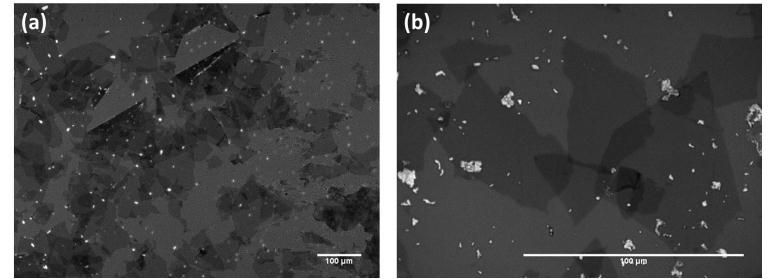
Fig.1: Image of reduced GO sheets on a SiO2/Si substrate. (a) Optical microscope image; and (b) higher magnification.
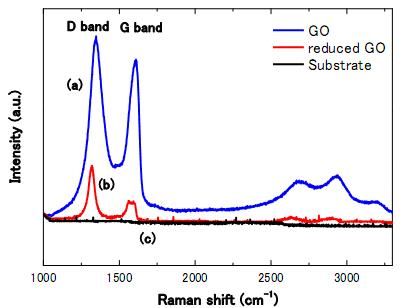
Fig. 2: Raman spectra of (a) chemically synthesized GO sheets, (b) reduced GO sheets after bacterial reduction without the addition of reducing agent and (c) the surface of SiO2.
The Toyohashi Tech Graphene Research Group at the Electronics Inspired Interdisciplinary Research Institute (EIIRIS) report on a method for producing high quality graphene by reducing graphene oxide flakes using easily extractable microorganisms.
Currently, the chemical reduction of graphene oxide (GO) flakes is the preferred choice for the mass production of graphene. Notably, the critical stage of reducing GO flakes into the 2-dimensional layers of carbon known as graphene involves exposure of the GO to hydrazine. This reduction processes have fundamental limitations for large scale production, in particular because of the hydrazine vapor is highly toxic.
The method developed by the Toyohashi Tech team was inspired by a recent report that graphene oxide behaves as a terminal electron acceptor for bacteria, where the GO is reduced by microbial action in the process of breathing or electron transport. Notably, the Toyohashi Graphene Research Group method is a hybrid approach, where chemically derived graphene oxide flakes are reduced by readily available microorganisms extracted from a river bank near the Tempaku Campus of Toyohashi University of Technology, Aichi, Japan. Raman scattering measurements showed that the GO flakes had indeed been reduced.



Other news from the department science