New genetic phenomenon discovered in Witrik cattle
Advertisement


By studying the DNA of Witrik, colour sided or lineback, cattle from various countries, scientists from the University of Liege have discovered that pieces of DNA move from one chromosome to another in a circle. This phenomenon had never before been identified in mammals. The research results were published in Nature.
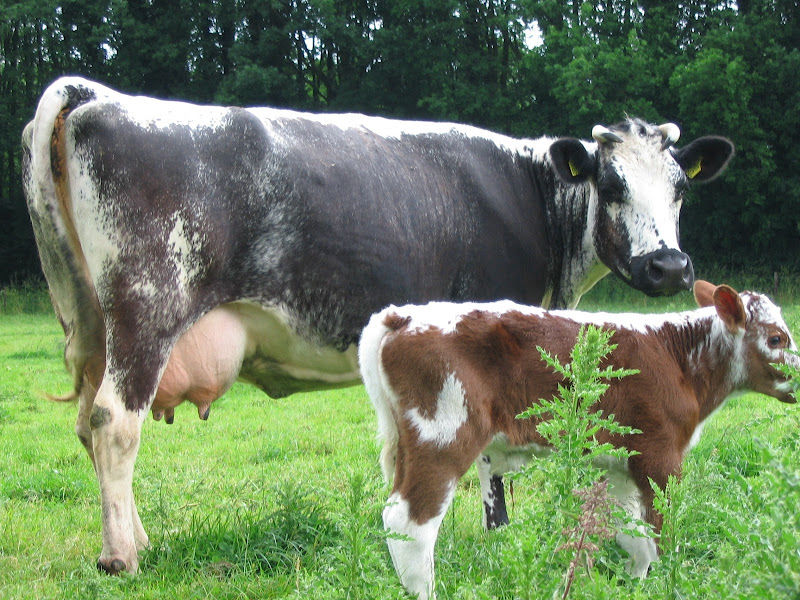
Witrik cattle
Witrik cattle are characterised by the white stripe on their backs, a marking that occurs in various cattle breeds. Within the original Fries-Hollands (Dutch-Friesian) and Maas-Rijn-IJssel (Meuse Rhine Yssel) cattle this colouration has been preserved by a small number of breeders. In addition to the Netherlands, the Witrik colour pattern occurs in Belgium in the Belgische Blauwe (Belgian White- Blue) and in Switzerland in the Brown Swiss (Braunvieh) breeds.
Scientists from various countries, including the Netherlands, collected DNA from Witrik cattle. In close cooperation with the Rare Breeds Survival Trust (Stichting Zeldzame Huisdierrassen), the Centre for Genetic Resources, part of Wageningen UR, the Netherlands collected DNA from a Witrik cattle family belonging to Dutch breeding farm Van der Veen.
Scientists from the Unit of Animal Genomics run by Michel Georges at the University of Liege have discovered that a piece of chromosome 6 formed a circle and then translocated to chromosome 29. Before the piece was built into chromosome 29 it broke open in another part of the circle. Whenever this circle is present on one of the two chromosomes nr 29, the Belgische Blauwe (Belgian White-Blue) and Dutch spotted animals develop the Witrik pattern. If the circle is built into both chromosomes 29 for the Witrik allele, the animal is almost completely white.
It was previously assumed that the Witrik pattern in cattle was the result of the effect of a gene on chromosome 6. When an animal had been given the spotted allele from one parent and the Witrik allele from the other, it was assumed that the heterozygote had the Witrik pattern.
The discovery will not lead to major changes for Witrik breeders, but finding the movement of pieces of DNA from one to another chromosome is an inspiration for scientists who study the genome of people and animals. It is interesting to find out whether the phenomenon also occurs in other mammals and whether it may cause genetic diseases. The research also shows the value of carefully preserving original breeds and colour patterns, including for genetic research.


Other news from the department science